China Leading Hydraulic Hose Manufacturer
Choosing between a China PVC hose manufacturer and a local supplier in Southeast Asia depends on order volume, product specifications, landed cost, delivery requirements, and after-sales support. For importers, wholesalers, and industrial distributors, sourcing directly from China can offer broader product options, OEM flexibility, and competitive bulk purchasing costs, while local suppliers may provide faster replenishment, smaller order quantities, and easier on-site support.
The best sourcing strategy is not necessarily choosing the lowest quotation. It is comparing the total landed cost, product consistency, supply reliability, and long-term business value.
This guide compares both sourcing options for B2B buyers in Malaysia, Indonesia, Thailand, Vietnam, the Philippines, Singapore, and other Southeast Asian markets.
1. Why Are Southeast Asian Buyers Comparing Chinese and Local PVC Hose Suppliers?
Southeast Asia is an important market for PVC hoses because of its agricultural, construction, manufacturing, mining, and industrial sectors.
Different industries require different hose constructions and performance characteristics.
For example:
- Agricultural distributors need PVC layflat hoses for irrigation and water distribution.
- Construction suppliers require durable water delivery hoses for construction sites.
- Industrial wholesalers purchase PVC steel wire hoses for suction and material transfer applications.
- Machinery and equipment distributors may need PVC spiral reinforced hoses.
- Hardware and agricultural wholesalers often purchase PVC garden hoses and spray hoses.
Buyers generally have two sourcing options:
- Purchase from local PVC hose manufacturers, distributors, or stockists.
- Import directly from Chinese PVC hose manufacturers and exporters.
Both options have advantages. However, the right choice depends on the buyer’s purchasing model.
Common purchasing challenges in Southeast Asia
| Buyer concern | Typical purchasing challenge |
|---|---|
| High purchasing costs | Local distributors may include additional distribution and inventory costs |
| Product consistency | Different suppliers may use different raw materials and reinforcement structures |
| Tropical climate | High temperatures, humidity, UV exposure, and outdoor storage can affect hose performance |
| Limited product selection | Local stockists may carry only popular specifications |
| Import logistics | Freight, customs clearance, and documentation affect landed costs |
| Inventory management | Large import orders require accurate demand forecasting |
| After-sales support | Buyers need reliable technical communication and claim-handling procedures |
For wholesalers and importers, the key question is whether direct importing can improve purchasing economics without creating unnecessary inventory and logistics risks.
2. China PVC Hose Manufacturer vs. Local Supplier: Key Differences
The following comparison summarizes the major differences between the two sourcing models.
| Comparison factor | Chinese PVC hose manufacturer | Local PVC hose supplier |
|---|---|---|
| Purchasing model | Direct factory sourcing or export trading | Local manufacturing, distribution, or stock supply |
| Bulk pricing | Potentially more competitive for suitable order volumes | May include local distribution costs |
| MOQ | Often depends on product, diameter, color, and customization | May offer smaller quantities from available stock |
| Product range | Can offer multiple hose constructions and specifications | Depends on local inventory and manufacturing capacity |
| OEM customization | Often offers private labeling, packaging, and customized specifications | Depends on supplier capabilities |
| Delivery | Requires international transportation and customs clearance | Usually faster for stocked products |
| Communication | May require coordination across time zones and languages | Easier local communication |
| Technical support | Depends on manufacturer’s export and engineering team | May provide local service or site support |
| Quality control | Can be checked through agreed specifications and inspection procedures | Easier physical inspection before purchase |
| Replenishment | Requires import planning | Usually more convenient for urgent replenishment |
Important: These are general sourcing characteristics, not universal guarantees. Some Chinese manufacturers maintain overseas warehouses, while some Southeast Asian suppliers operate their own manufacturing facilities.
The actual quotation, manufacturing capability, stock availability, and service level should always be verified.
 3. Why Do Many Southeast Asian Wholesalers Source PVC Hoses from China?
China is an established manufacturing and export base for various PVC hose products.
For Southeast Asian distributors, direct sourcing may be particularly attractive when they need multiple product categories, consistent bulk orders, or private-label products.
3.1 More product options for wholesale distribution
A direct manufacturer may offer several PVC hose categories through one sourcing relationship.
Common products include:
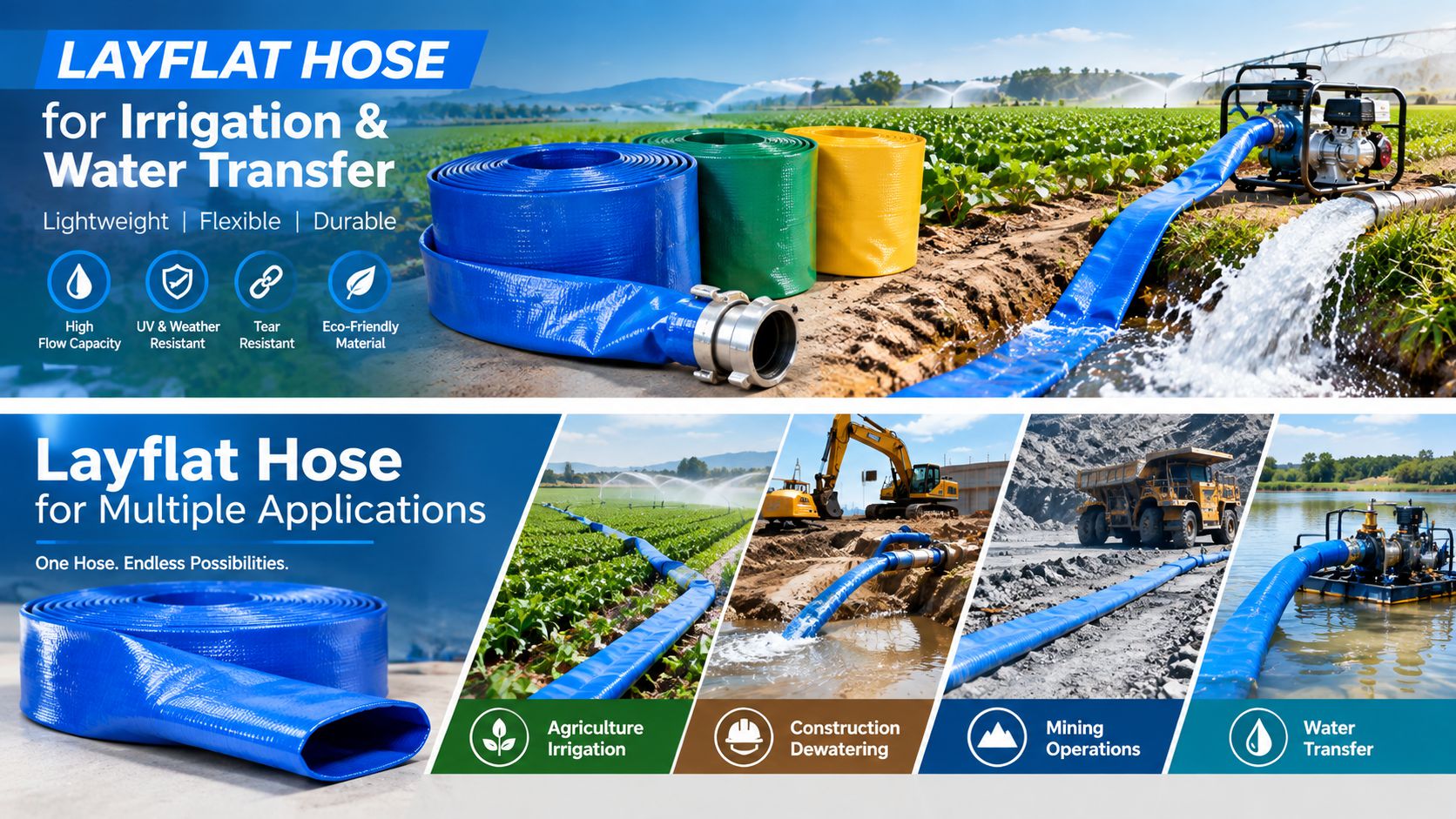
Used for agricultural irrigation, water transfer, drainage, and general water distribution.
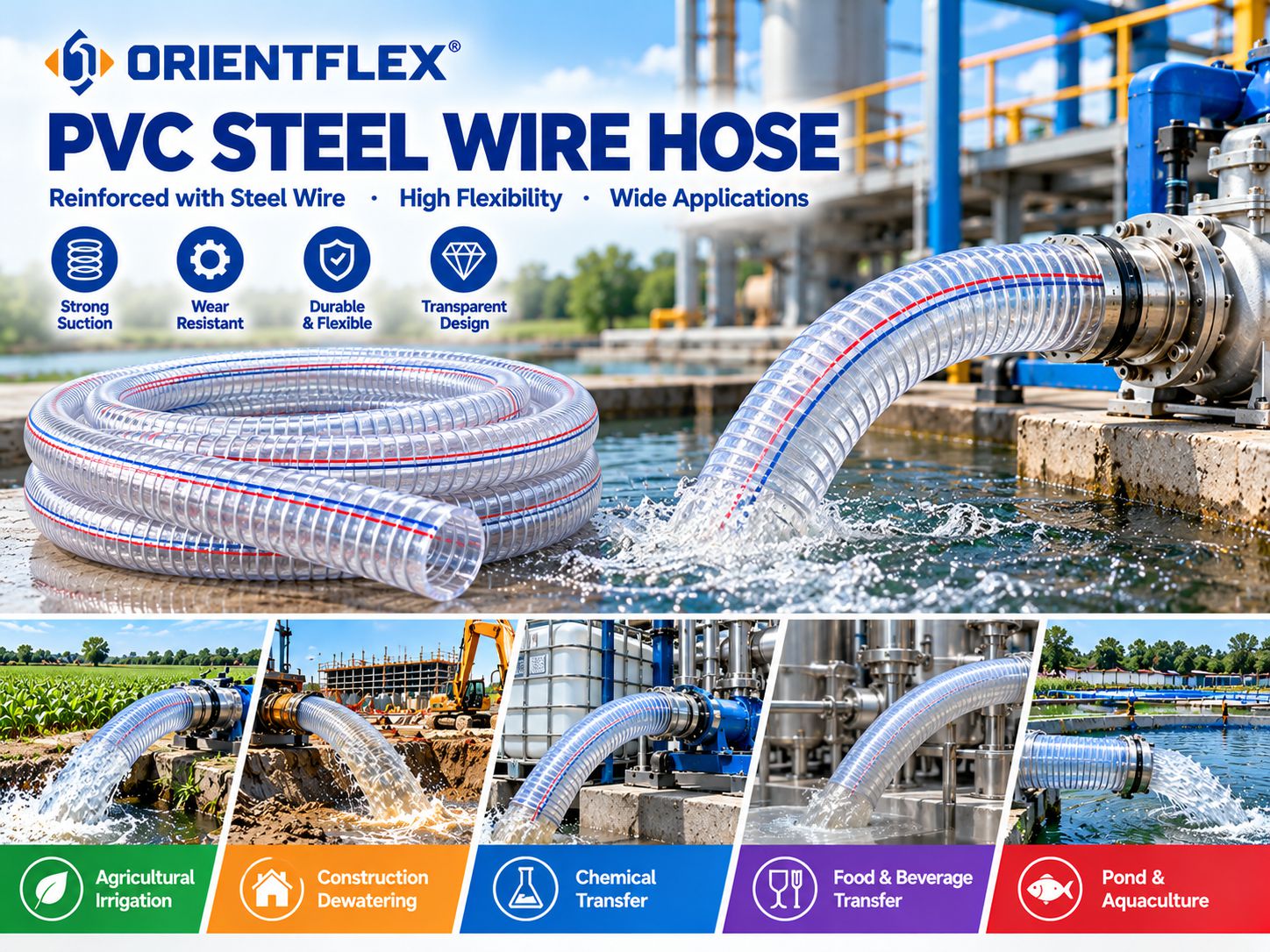
Designed for suction and discharge applications where a transparent or flexible hose with steel-wire reinforcement is required.
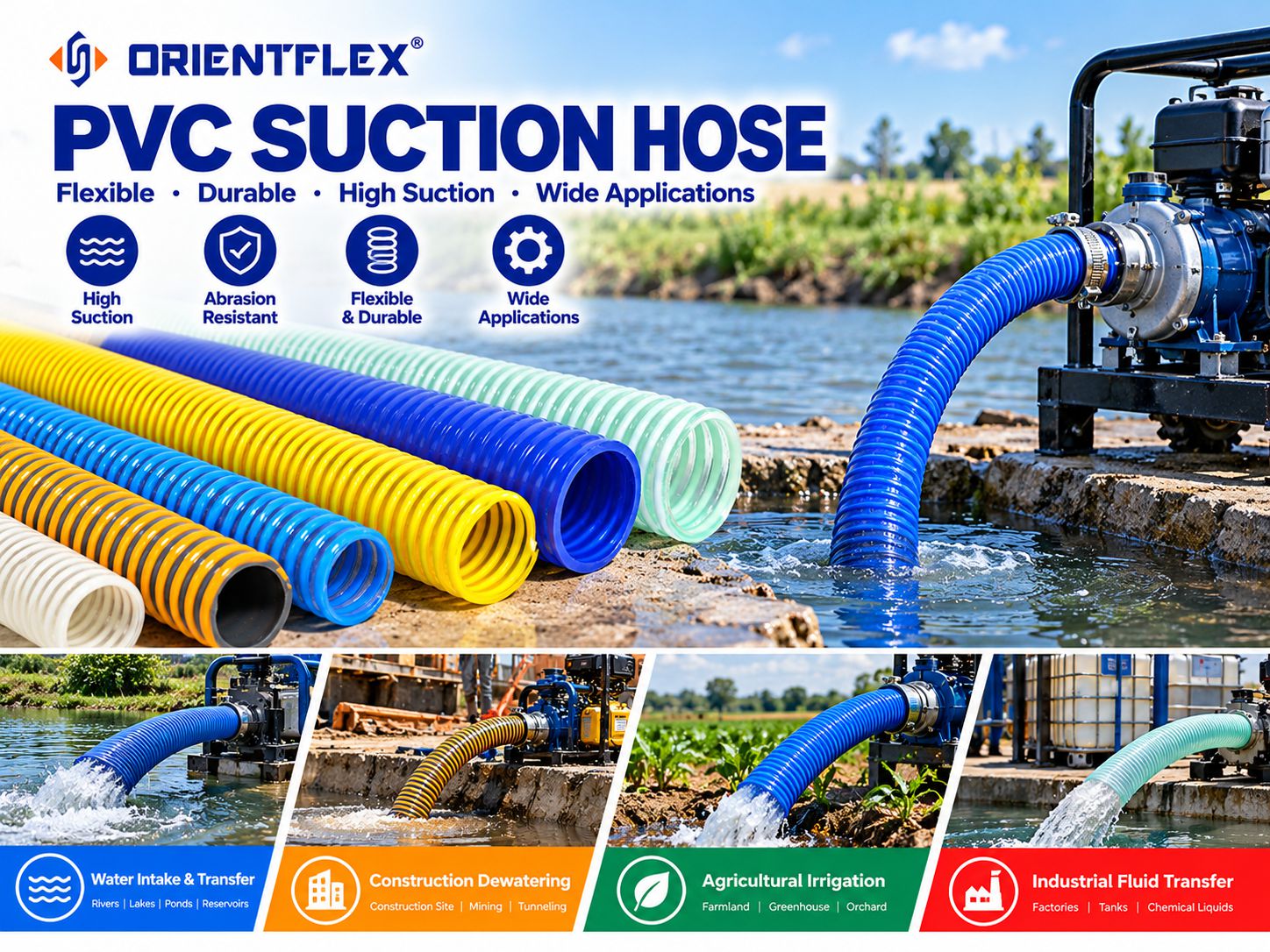
Uses a rigid PVC spiral reinforcement to support the hose structure in suitable suction and delivery applications.
Suitable for general water delivery, industrial applications, and agricultural spraying, depending on its pressure rating and construction.
Used for gardening, landscaping, agricultural watering, and general water delivery.
For distributors in Indonesia, Vietnam, Thailand, Malaysia, and the Philippines, sourcing several product categories from one manufacturer can simplify supplier management and product planning.
3.2 OEM and private-label opportunities
Many B2B importers want to develop their own brands rather than resell unbranded products.
Depending on factory capability and order requirements, Chinese manufacturers may support:
- Customized hose colors.
- Printed company logos.
- Customized packaging and labeling.
- Private-label branding.
- Selected diameter and length combinations.
- Product-specific reinforcement and material options.
Before placing a customized order, buyers should confirm the available customization options, printing method, MOQ, production lead time, and sample approval process.
3.3 Better cost control for suitable order volumes
Direct importing can reduce the number of intermediaries between the manufacturer and the distributor.
However, a lower factory quotation does not automatically mean a lower purchasing cost.
Buyers should compare the complete landed cost:
Landed Cost = Product Cost + Inland Transportation + Export Charges + International Freight + Insurance + Import Duty + Taxes + Customs Clearance + Local Delivery
The calculation should use the same product specifications, shipment quantity, Incoterm, and delivery destination.
A local quotation should also be checked for equivalent specifications and included services.
3.4 More flexibility in product development
Distributors often serve different customer segments.
An agricultural distributor may require PVC layflat hoses, while an industrial supplier may need PVC steel wire and spiral reinforced hoses.
Working directly with a manufacturer can make it easier to discuss product adjustments, request samples, and develop a consistent product portfolio.
However, customization should always be supported by written specifications and approved samples.
 4. When Is a Local PVC Hose Supplier a Better Choice?
Direct importing is not always the most economical solution.
Local suppliers can provide important advantages, especially for businesses with urgent replenishment requirements.
4.1 Urgent delivery and small-volume purchasing
If a distributor needs a limited quantity of PVC hoses immediately, purchasing from local stock may be more practical.
Local sourcing can reduce:
- International shipping arrangements.
- Import documentation.
- Customs clearance procedures.
- Minimum order pressure.
- Inventory financing requirements.
For businesses with unpredictable demand, these advantages can outweigh a potentially higher unit price.
4.2 Local technical support
Some applications require on-site product inspection, installation assistance, or rapid replacement.
A local supplier may be better positioned to provide these services.
This is particularly relevant to industrial users, construction contractors, and machinery maintenance businesses.
4.3 Lower inventory risk
Direct imports normally require more careful demand forecasting.
If a distributor imports too much stock, it may face:
- Slow inventory turnover.
- Warehousing expenses.
- Working capital pressure.
- Changes in customer specifications.
- Overstocking of unpopular diameters or colors.
Local purchasing can help distributors replenish stock according to immediate demand.
4.4 Easier communication and claim handling
Local suppliers may offer easier communication, local currency quotations, and more convenient return or replacement arrangements.
However, buyers should still evaluate warranty terms, technical competence, and the supplier’s actual stock availability.
 5. PVC Hose Performance Requirements in Southeast Asia
Southeast Asia includes tropical, coastal, agricultural, industrial, and urban environments.
A PVC hose that performs well in one application may not be suitable for another.
Buyers should evaluate the actual operating conditions rather than selecting a product based only on its appearance or price.
5.1 High temperature and humidity
Countries such as Malaysia, Indonesia, Thailand, Vietnam, and the Philippines experience tropical weather conditions.
For hoses used outdoors, buyers should consider:
- Operating temperature.
- Exposure to direct sunlight.
- UV resistance requirements.
- Flexibility after repeated use.
- Storage conditions.
- Resistance to environmental aging.
Do not assume that every PVC hose is automatically UV-resistant or suitable for continuous outdoor exposure.
Request supporting test information or product-specific performance data.
5.2 Agricultural irrigation applications
Agricultural wholesalers often purchase PVC layflat hoses and PVC fibre reinforced hoses.
Typical applications include:
- Irrigation water distribution.
- Farm water transfer.
- Greenhouse irrigation.
- Orchard and plantation watering.
- General agricultural water supply.
For irrigation projects in Indonesia, Malaysia, Thailand, and Vietnam, buyers should confirm the required hose diameter, working pressure, length, coupling compatibility, and expected service conditions.
5.3 Industrial suction and discharge
For industrial applications, PVC steel wire hoses and PVC spiral reinforced hoses may be considered.
Important purchasing parameters include:
- Suction or discharge requirements.
- Vacuum resistance.
- Working pressure.
- Reinforcement material.
- Media compatibility.
- Minimum bending radius.
- Abrasion exposure.
A standard water-transfer PVC hose should not automatically be selected for chemical, oil, or abrasive-material applications.
Always check the manufacturer’s compatibility data.
5.4 Construction and infrastructure projects
Construction distributors may require PVC layflat hoses and reinforced water delivery hoses for:
- Water supply.
- Site drainage.
- Temporary water transfer.
- General construction operations.
For these applications, durability, pressure stability, connection compatibility, and replacement availability are important purchasing considerations.
6. Which PVC Hose Specifications Should B2B Buyers Compare?
One of the biggest mistakes in supplier comparison is evaluating products based only on nominal diameter or price per meter.
Two hoses with the same nominal diameter may have different wall thicknesses, reinforcement structures, pressure ratings, and tolerances.
The following checklist can help importers compare quotations accurately.
| Specification | What buyers should confirm | Why it matters |
|---|---|---|
| Inner diameter | Actual ID in mm or inches | Determines connection compatibility and flow capacity |
| Outer diameter | Actual OD | Affects fitting compatibility |
| Wall thickness | Measured thickness in mm | Influences hose construction |
| Working pressure | Rated pressure in bar or MPa | Determines safe operating conditions |
| Burst pressure | Tested burst pressure | Helps evaluate pressure safety margins |
| Temperature range | Product-specific operating limits | Important for tropical and industrial applications |
| Reinforcement | Polyester yarn, steel wire, or PVC spiral | Determines structural performance |
| Length | Standard or customized length | Affects purchasing and packaging |
| Material | PVC compound and reinforcement materials | Influences flexibility and durability |
| Color | Available production colors | Supports product identification and branding |
| Tolerance | Agreed dimensional tolerances | Supports consistent installation and quality control |
Relevant international testing and dimensional standards
Buyers can use recognized standards to establish a more consistent inspection process.
ISO 1307:2006 – Rubber and plastics hoses: Hose sizes and tolerances
This standard addresses hose sizes, minimum and maximum inside diameters, and tolerances on cut-to-length hoses. Its current status should be checked through ISO before specifying it in a purchase contract.
ISO 1402:2021 – Rubber and plastics hoses and hose assemblies: Hydrostatic testing
This standard specifies methods for hydrostatic testing, including the determination of dimensional stability.
ISO 3994:2026 – Helical-thermoplastic-reinforced thermoplastics hoses
The latest edition specifies requirements for three types of reinforced thermoplastic hoses used for suction and discharge of water, weak aqueous chemical solutions, and abrasive solids and slurries.
Its specified ambient temperature range is −10°C to +55°C. It does not cover flammable or combustible materials or aromatic solvents.
These standards do not mean that every PVC hose product automatically complies with them. Buyers must confirm the applicable product scope and request relevant test evidence.
7. Importing PVC Hoses from China to Southeast Asia: Logistics and Cost Considerations
International transportation is a major part of direct-import purchasing decisions.
The best shipping arrangement depends on the destination country, order volume, packaging method, and delivery terms.
7.1 Major Southeast Asian ports for PVC hose imports
| Destination market | Important port examples | Purchasing considerations |
|---|---|---|
| Malaysia | Port Klang, Port of Tanjung Pelepas, Penang Port | Distribution to Kuala Lumpur, Selangor, Johor, and Penang |
| Indonesia | Tanjung Priok, Tanjung Perak | Distribution to Java and other Indonesian islands |
| Thailand | Laem Chabang, Bangkok Port | Distribution to Bangkok and industrial regions |
| Vietnam | Cat Lai, Cai Mep–Thi Vai, Hai Phong | Southern and northern distribution networks |
| Philippines | Port of Manila, Cebu Port | Island-based distribution and domestic transport |
| Singapore | Port of Singapore | Regional distribution and transshipment |
These are examples of relevant port gateways, not a ranking of shipping routes or a guarantee of direct service from every Chinese loading port.
7.2 FCL vs. LCL shipping
Importers generally consider two shipping options.
FCL (Full Container Load)
Suitable when purchasing volumes are sufficient to justify booking a full container.
Potential advantages:
- Better control over cargo loading.
- Fewer consolidation handling steps.
- More predictable container planning.
- Potentially lower freight cost per unit at suitable volumes.
LCL (Less than Container Load)
Suitable for smaller orders that do not require a full container.
Potential advantages:
- Lower initial cargo commitment.
- Easier product testing.
- More flexible purchasing quantities.
However, LCL may involve additional consolidation, handling, and destination charges.
Buyers should compare the complete logistics cost rather than freight alone.
7.3 Important import documents
Depending on the destination country and shipment arrangement, the documents may include:
- Commercial invoice.
- Packing list.
- Bill of lading.
- Certificate of origin, where required.
- Product specifications.
- Relevant inspection or test reports.
- Import permits or additional regulatory documents, where applicable.
Import duties, taxes, tariff classifications, and product-specific regulatory requirements vary by country.
Buyers should confirm the correct HS classification with their customs broker or local customs authority before shipment.
Do not assume that preferential ASEAN tariff treatment applies to goods manufactured in China simply because the destination is an ASEAN member country.
The applicable free trade agreement, origin rules, and supporting documentation must be checked separately.
8. Country-Specific PVC Hose Sourcing Considerations
Southeast Asia is not a single uniform market.
Importers should adapt their sourcing strategies to local industrial demand, logistics, and distribution structures.
Malaysia
Potential purchasing sectors: Agriculture, construction, industrial distribution, manufacturing, and plantations.
Recommended products to evaluate:
- PVC layflat hose.
- PVC steel wire hose.
- PVC fibre reinforced hose.
- PVC spiral reinforced hose.
Port Klang is an important logistics gateway for importers serving the Klang Valley and other Malaysian regions.
Buyers should compare local stock availability with direct-import pricing, especially for repeat wholesale orders.
Indonesia
Potential purchasing sectors: Agriculture, plantations, construction, mining, and industrial distribution.
Products worth evaluating:
- PVC layflat hose for water transfer.
- PVC spiral reinforced hose for suitable suction applications.
- PVC steel wire hose for industrial suction and discharge.
- PVC spray hose for agricultural applications.
For Indonesian importers, domestic distribution costs and inter-island logistics should be included in the purchasing calculation.
Thailand
Potential purchasing sectors: Agriculture, manufacturing, construction, and industrial equipment distribution.
Recommended products to evaluate:
- PVC layflat hose.
- PVC garden hose.
- PVC fibre reinforced hose.
- PVC steel wire hose.
Buyers should compare local inventory and factory-direct sourcing based on annual demand and delivery frequency.
Vietnam
Potential purchasing sectors: Agriculture, aquaculture, manufacturing, construction, and industrial supply.
Relevant products may include:
- PVC layflat hose.
- PVC spray hose.
- PVC fibre reinforced hose.
- PVC spiral reinforced hose.
For buyers serving northern and southern Vietnam, warehouse location and inland transportation costs should be included in the supplier evaluation.
Philippines
Potential purchasing sectors: Agriculture, construction, water distribution, and industrial maintenance.
Products to consider:
- PVC layflat hose.
- PVC garden hose.
- PVC reinforced water hose.
- PVC steel wire hose for suitable industrial applications.
Because the Philippines is an archipelago, domestic transportation and regional inventory planning are important considerations.
Singapore
Potential purchasing sectors: Industrial distribution, equipment supply, marine-related industries, and regional trading.
Singapore-based buyers may prioritize:
- Consistent product specifications.
- Reliable documentation.
- OEM supply.
- Efficient regional distribution.
- Technical product information.
A local supplier may be preferable for urgent maintenance orders, while direct manufacturer sourcing may be attractive for planned wholesale and regional distribution programs.
9. How to Calculate the Real Cost: China vs. Local Sourcing
A professional purchasing decision should be based on total landed cost per sellable unit.
Consider the following illustrative calculation.
Example: Comparing two quotations for the same PVC hose specification
The figures below are hypothetical and are provided only to demonstrate the calculation method. They are not market quotations or verified Southeast Asian freight rates.
| Cost item | Direct import from China | Local purchase |
|---|---|---|
| Product purchase cost | $10,000 | $12,000 |
| International freight and insurance | $1,200 | Included |
| Import duty and taxes | $500 | Included in local price |
| Customs and handling | $300 | $0 |
| Local delivery | $300 | $0 |
| Total cost | $12,300 | $12,000 |
| Total sellable quantity | 10,000 m | 10,000 m |
| Cost per meter | $1.23 | $1.20 |
In this example, local sourcing is slightly cheaper, despite the lower factory purchase price in China.
However, the comparison may change when:
- Import quantities increase.
- Freight rates change.
- The importer negotiates better factory pricing.
- Local distributor prices increase.
- Additional products are consolidated into one shipment.
The most important calculation
Cost per Sellable Meter = Total Landed Cost ÷ Actual Sellable Hose Length
This calculation should also account for damaged goods, inspection failures, and other unavoidable losses where applicable.
For distributors, profitability depends on both purchasing cost and inventory turnover.
A low-cost product that stays in the warehouse for 12 months may be less attractive than a slightly more expensive product with faster turnover.
10. How to Choose a Reliable China PVC Hose Manufacturer
Not every Chinese supplier is a direct manufacturer.
Some companies operate as trading businesses, while others manufacture only selected product categories.
Before placing a bulk order, Southeast Asian buyers should evaluate the supplier using the following checklist.
10.1 Verify manufacturing capabilities
Ask the supplier:
- Does the company manufacture PVC hoses directly?
- Which product categories are produced in-house?
- Can it provide production and product inspection information?
- Does it support OEM and private-label orders?
- Can it supply consistent specifications for repeat orders?
10.2 Request product samples
Before confirming a large order, request samples of the intended product.
Check:
- Actual inside and outside diameters.
- Wall thickness.
- Flexibility.
- Reinforcement structure.
- Surface appearance.
- Working pressure requirements.
- Connection compatibility.
10.3 Request product-specific test reports
Ask for relevant reports covering:
- Dimensional inspection.
- Hydrostatic pressure testing.
- Burst pressure testing.
- Vacuum resistance, where applicable.
- Temperature performance.
- UV or aging resistance, where required.
Test reports should identify the tested product, sample, method, and results.
A general factory certificate should not be treated as proof that every hose model meets the buyer’s specifications.
10.4 Confirm production and delivery arrangements
Before issuing a purchase order, agree on:
- Product specifications.
- Quantity and acceptable tolerances.
- Production lead time.
- Packaging requirements.
- Shipping terms.
- Inspection arrangements.
- Warranty and claim procedures.
10.5 Evaluate communication and long-term support
A reliable supplier should be able to explain product differences, identify unsuitable applications, and respond clearly to technical questions.
The objective is to establish a stable sourcing relationship rather than simply obtain the lowest quotation.
11. Why Consider Orientflex as a PVC Hose Supplier in China?
For Southeast Asian wholesalers, importers, and industrial distributors looking for a broader hose product portfolio, Orientflex is a China-based hose supply option worth evaluating.
Orientflex focuses on PVC hoses, rubber hoses, and hose connectors and fittings, providing a potential one-stop sourcing channel for buyers who want to consolidate multiple hose-related purchasing requirements.
Product categories buyers can explore include:
- PVC layflat hoses.
- PVC steel wire hoses.
- PVC spiral reinforced hoses.
- PVC fibre reinforced hoses.
- PVC garden hoses.
- Rubber industrial hoses.
- Hydraulic hoses and related hose products.
- Hose connectors and fittings.
For distributors in Malaysia, Indonesia, Thailand, Vietnam, the Philippines, and Singapore, a multi-category supplier may help simplify sourcing and product portfolio management.
Before confirming an order, buyers should request the latest product catalog, detailed technical specifications, available samples, MOQ, OEM conditions, and shipment quotations.
Supplier selection should be based on verified product capabilities and the buyer’s actual requirements.
Official website: https://www.orientflexhose.com/
12. Frequently Asked Questions
Q1: Is buying PVC hoses directly from China cheaper than buying from local suppliers in Southeast Asia?
Not always. Chinese manufacturers may offer competitive factory pricing for suitable bulk orders, but import freight, customs charges, taxes, local transportation, and inventory costs must be included.
Compare the total landed cost per sellable meter before making a decision.
Q2: What is the MOQ for importing PVC hoses from China?
There is no universal MOQ for all PVC hose products.
MOQ depends on the hose type, diameter, color, length, packaging, customization requirements, and manufacturer’s production arrangements.
Request an MOQ quotation for each product specification.
Q3: Which PVC hose is suitable for agricultural irrigation in Southeast Asia?
PVC layflat hoses and PVC fibre reinforced hoses are commonly considered for agricultural water delivery.
The final selection depends on water pressure, diameter, required length, operating temperature, and field conditions.
Q4: Can Chinese PVC hose manufacturers provide OEM services for Southeast Asian distributors?
Many manufacturers offer OEM options, but available services differ.
Buyers should confirm logo printing, customized colors, packaging, labeling, MOQ, and production arrangements before ordering.
Q5: How long does it take to ship PVC hoses from China to Malaysia, Indonesia, Thailand, or Vietnam?
Shipping time depends on the Chinese loading port, destination port, shipping service, transshipment arrangements, customs clearance, and inland transportation.
Ask the freight forwarder for a current route-specific transit estimate rather than relying on a general regional shipping figure.
Q6: What documents are required to import PVC hoses into Southeast Asia?
Common shipping documents include a commercial invoice, packing list, and bill of lading. A certificate of origin, technical documents, inspection reports, or additional permits may be required depending on the destination and product classification.
Always confirm requirements with the local customs authority or licensed customs broker.
Q7: How can importers check PVC hose quality before bulk purchasing?
Request representative samples, product specifications, dimensional inspection results, and relevant pressure-test reports.
For pressure testing, ISO 1402:2021 provides recognized hydrostatic test methods for rubber and plastics hoses and hose assemblies.
Q8: Can PVC hoses withstand Southeast Asia’s tropical climate?
Performance depends on the PVC formulation, reinforcement, operating temperature, UV exposure, storage conditions, and application.
Buyers should request product-specific temperature and weather-resistance data instead of assuming all PVC hoses are suitable for continuous outdoor exposure.
Q9: Should I choose a PVC hose manufacturer or a local distributor?
Choose direct factory sourcing when you have recurring bulk demand, need OEM products, or want a broader product portfolio.
Choose local distribution when you prioritize urgent replenishment, small quantities, and local technical support.
A hybrid sourcing strategy can also work well.
Q10: What should I include when requesting a PVC hose quotation?
Provide the following information:
- Hose type.
- Inner diameter and outer diameter.
- Working pressure.
- Required length per roll.
- Quantity.
- Color and reinforcement requirements.
- Packaging and OEM requirements.
- Destination port or delivery address.
- Preferred Incoterm.
The more specific the inquiry, the more accurate the quotation can be.
Conclusion: China Manufacturer or Local Supplier – Which Is the Better Choice?
For Southeast Asian B2B buyers, choosing between a China PVC hose manufacturer and a local supplier depends on purchasing volume, delivery urgency, technical requirements, and total landed cost.
Choose a Chinese manufacturer when:
- You purchase PVC hoses regularly in wholesale quantities.
- You need multiple hose categories from one supplier.
- You want OEM and private-label options.
- You can plan inventory and international shipments.
- You want to compare factory-direct sourcing economics.
Choose a local supplier when:
- You need urgent stock replenishment.
- You purchase small quantities.
- You require local technical support.
- You want to reduce international inventory and logistics risks.
For many distributors, combining direct imports for planned bulk orders with local purchasing for urgent requirements can provide a more flexible supply strategy.
Looking for a Reliable PVC Hose Manufacturer in China?
Orientflex welcomes inquiries from PVC hose importers, wholesalers, distributors, and industrial supply companies across Southeast Asia.
Whether you are sourcing PVC layflat hoses, PVC steel wire hoses, PVC spiral reinforced hoses, PVC fibre reinforced hoses, or other hose products, our team can help you evaluate suitable product options.
Contact Orientflex to request:
- A product catalog and technical specifications.
- Wholesale pricing for your required quantities.
- OEM and private-label information.
- Product samples and quality documentation.
- Shipping quotations to Malaysia, Indonesia, Thailand, Vietnam, the Philippines, and Singapore.
Send us your product requirements, order quantity, and destination port to discuss a suitable sourcing solution for your business.
Website: https://www.orientflexhose.com/
Related posts


