China Leading Hydraulic Hose Manufacturer
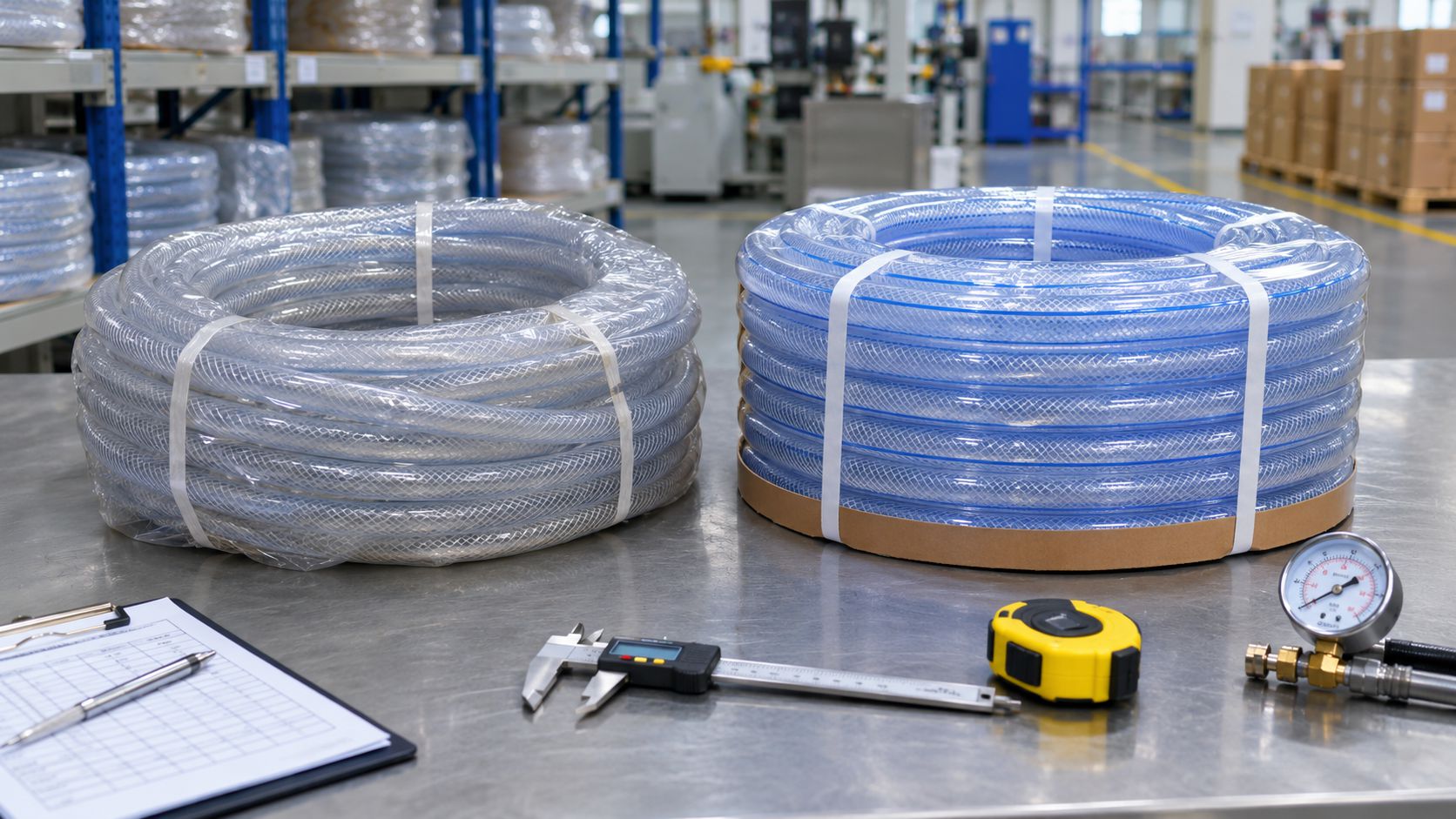
Cheap PVC hoses can reduce initial purchasing costs, but quality PVC hoses offer better procurement value when they deliver verified pressure performance, consistent dimensions, and fewer product failures. For importers and wholesale distributors in Indonesia, Vietnam, Thailand, the Philippines, and Malaysia, the best choice is not simply the lowest price per meter. It is the hose that meets the required specifications at the lowest sustainable cost per saleable meter.
This guide compares cheap and quality PVC hoses based on materials, wall thickness, pressure ratings, tropical-climate suitability, and wholesale import costs.
It also explains how Southeast Asian importers can evaluate Chinese PVC hose manufacturers before placing 20GP or 40HQ container orders.
1. Cheap PVC Hose vs Quality PVC Hose: What Is the Real Difference?
The difference between cheap and quality PVC hoses is primarily determined by measurable manufacturing and performance characteristics.
A low-cost hose is not necessarily defective. It may be manufactured for a lighter-duty application, use a different construction, or benefit from efficient production.
However, purchasing risk increases when a supplier offers a low price without verifiable technical specifications or consistent quality control.
Cheap vs Quality PVC Hose Comparison
| Quality Factor | Potential Risk with Unverified Low-Cost Hoses | Quality-Controlled PVC Hoses |
|---|---|---|
| PVC formulation | Inconsistent compound properties | Controlled formulation for specified applications |
| Wall thickness | Undocumented variation | Defined nominal thickness and tolerances |
| Reinforcement | Inconsistent braid or spiral construction | Consistent reinforcement design |
| Working pressure | Unsupported pressure claims | Documented pressure ratings |
| Burst pressure | Limited test evidence | Defined test requirements and records |
| Temperature performance | Unclear operating limits | Specified temperature and pressure limitations |
| UV resistance | Outdoor suitability not verified | Test-backed outdoor suitability where required |
| Roll length | Possible shortages or disputes | Agreed lengths and verification |
| Batch consistency | Variable dimensions or performance | Recorded quality checks |
| Customer claims | Higher uncertainty | More predictable when requirements are verified |
Key takeaway: A quality PVC hose is one that consistently meets its documented specification. A higher price alone does not establish quality, and a lower price alone does not establish poor quality.
For wholesale importers, the goal is to compare equivalent products and verify the performance required by their downstream customers.
2. Why PVC Hose Quality Matters in Southeast Asia
Southeast Asia has a wide variety of agricultural, manufacturing, construction, and water-management applications that use flexible hoses.
Importers in the region often supply different customers, including irrigation equipment distributors, industrial suppliers, water pump wholesalers, and construction material dealers.
The technical requirements vary by application and country.
Southeast Asian Market Applications
| Country | Relevant Applications | Key Purchasing Considerations |
|---|---|---|
| Indonesia | Irrigation, water transfer, construction, industrial distribution | Outdoor suitability, pressure reliability, inter-island distribution |
| Vietnam | Agriculture, factory water systems, industrial supply | Specification consistency, competitive wholesale cost |
| Thailand | Agriculture, industrial fluid transfer, construction | Application-specific pressure and temperature ratings |
| Philippines | Irrigation, drainage, construction, water transfer | Port logistics, installation conditions, pressure reliability |
| Malaysia | Industrial distribution, agriculture, general fluid transfer | Technical documentation, material compatibility |
| Cambodia | Agricultural irrigation, water pumping, construction | Durability, affordability, product availability |
These are relevant end-use applications, not verified rankings of demand by country.
Tropical Climate Challenges
Many Southeast Asian markets experience high ambient temperatures, substantial humidity, and frequent rainfall.
PVC hose performance depends on operating conditions, not just regional climate.
Important considerations include:
- Elevated hose surface temperature under direct sunlight.
- Reduced allowable pressure at higher operating temperatures for certain hose designs.
- Outdoor UV exposure.
- Abrasion during agricultural or construction use.
- Storage conditions inside warehouses and containers.
- Compatibility with the fluids being transported.
Importers should request temperature-dependent pressure data and applicable weathering test evidence instead of assuming that every PVC hose is suitable for tropical outdoor use.
3. Five Technical Differences Between Cheap and Quality PVC Hoses
3.1 PVC Compound and Raw Material Consistency
Flexible PVC hoses are commonly manufactured using PVC resin, plasticizers, stabilizers, pigments, and other additives.
The formulation affects flexibility, mechanical properties, appearance, and suitability for different operating conditions.
A supplier may use different formulations to achieve different price and performance targets.
However, material composition alone does not establish whether a hose is suitable for an application.
What Importers Should Ask
- Is the PVC compound formulation controlled between production batches?
- Is the hose designed for the intended operating temperature?
- Are material changes subject to customer approval?
- Is relevant material compliance documentation available?
- Can the supplier provide samples for independent testing?
Important: Claims such as “100% pure PVC” are not technically sufficient for evaluating flexible PVC hose quality. Flexible PVC products generally require additives.
A better purchasing requirement is a controlled formulation supported by measurable performance criteria.
3.2 Wall Thickness and Dimensional Tolerances
Wall thickness is an important construction parameter.
However, thicker does not always mean stronger because pressure resistance also depends on material properties, reinforcement, and hose design.
For example, consider a hypothetical PVC fiber reinforced hose specification.
| Parameter | Illustrative RFQ Requirement |
|---|---|
| Nominal inner diameter | 25 mm |
| Nominal outer diameter | 33 mm |
| Nominal wall thickness | 4 mm |
| Example wall tolerance | ±0.3 mm |
| Roll length | 50 m |
| Working pressure | 8 bar at 20°C |
These values are a purchasing example, not a verified Orientflex product specification or universal industry tolerance.
Wall thickness can be calculated from nominal dimensions:
Wall thickness = (Outer diameter − Inner diameter) ÷ 2
For this example:
(33 − 25) ÷ 2 = 4 mm
Importers should define the measurement procedure and acceptance tolerances before production.
For reference, ISO 1307:2006 addresses certain rubber and plastics hose dimensions and tolerances. Its applicability should be checked against the exact hose product.
3.3 Working Pressure and Burst Pressure
Pressure ratings are among the most important technical factors when comparing PVC hoses.
Working pressure refers to the specified allowable operating pressure under defined conditions.
Burst pressure refers to the pressure at which a hose fails during a specified test.
The two ratings are not interchangeable.
Illustrative Pressure Specification
| Parameter | Example Requirement |
|---|---|
| Working pressure | 8 bar |
| Minimum burst pressure | 24 bar |
| Burst-to-working-pressure ratio | 3:1 |
| Reference temperature | 20°C |
| Testing reference | ISO 1402:2021, where applicable |
The 3:1 ratio is an illustrative specification, not a universal PVC hose safety requirement.
Actual requirements depend on hose design, application, applicable standards, and manufacturer specifications.
ISO 1402:2021, Rubber and plastics hoses and hose assemblies — Hydrostatic testing, is a recognized reference for hydrostatic testing.
Buyers should request test reports that identify the method, test conditions, hose sample, and results.
3.4 Temperature and UV Resistance in Tropical Markets
A PVC hose rated at 8 bar at 20°C must not automatically be treated as an 8-bar hose at 40°C or higher.
The allowable operating pressure may change with temperature.
For tropical-market procurement, buyers should consider these illustrative exposure conditions:
| Condition | Purchasing Requirement |
|---|---|
| 20°C reference temperature | Confirm rated working pressure |
| 30°C ambient conditions | Verify applicable temperature-pressure data |
| 40°C operating environment | Confirm allowable pressure from the datasheet |
| Direct outdoor sunlight | Request relevant UV/weathering evidence |
| Long-term outdoor storage | Confirm storage and aging recommendations |
The temperatures describe evaluation scenarios, not certified temperature limits for all PVC hoses.
If hose surface temperatures become higher than ambient air temperatures, the manufacturer should confirm whether the product remains suitable.
Why UV Resistance Matters
PVC hose compounds may respond differently to long-term sunlight exposure.
Depending on the formulation and conditions, aging can affect flexibility, appearance, and mechanical properties.
Buyers should not use hose color alone as proof of UV resistance.
If outdoor performance is critical, request relevant accelerated weathering evidence, such as testing based on ISO 4892 methods where applicable, along with appropriate acceptance criteria.
3.5 Reinforcement and Product Construction
Different PVC hose types are designed for different uses.
| PVC Hose Type | Construction | Applications to Evaluate |
|---|---|---|
| PVC fiber reinforced hose | Textile braid reinforcement | Pressurized water and air delivery |
| PVC steel wire hose | Steel wire helix | Certain suction and discharge applications |
| PVC suction hose | Rigid spiral reinforcement | Pump suction and drainage |
| PVC layflat hose | Flexible, reinforced layflat construction | Irrigation and water discharge |
| PVC transparent hose | Often unreinforced construction | Selected low-pressure fluid transfer |
A PVC layflat hose should not be selected for suction service unless its specific construction is rated for that application.
Likewise, a pressure-rated delivery hose is not automatically suitable for vacuum operation.
B2B purchasing principle: Match the hose construction to the end-use application before comparing price.
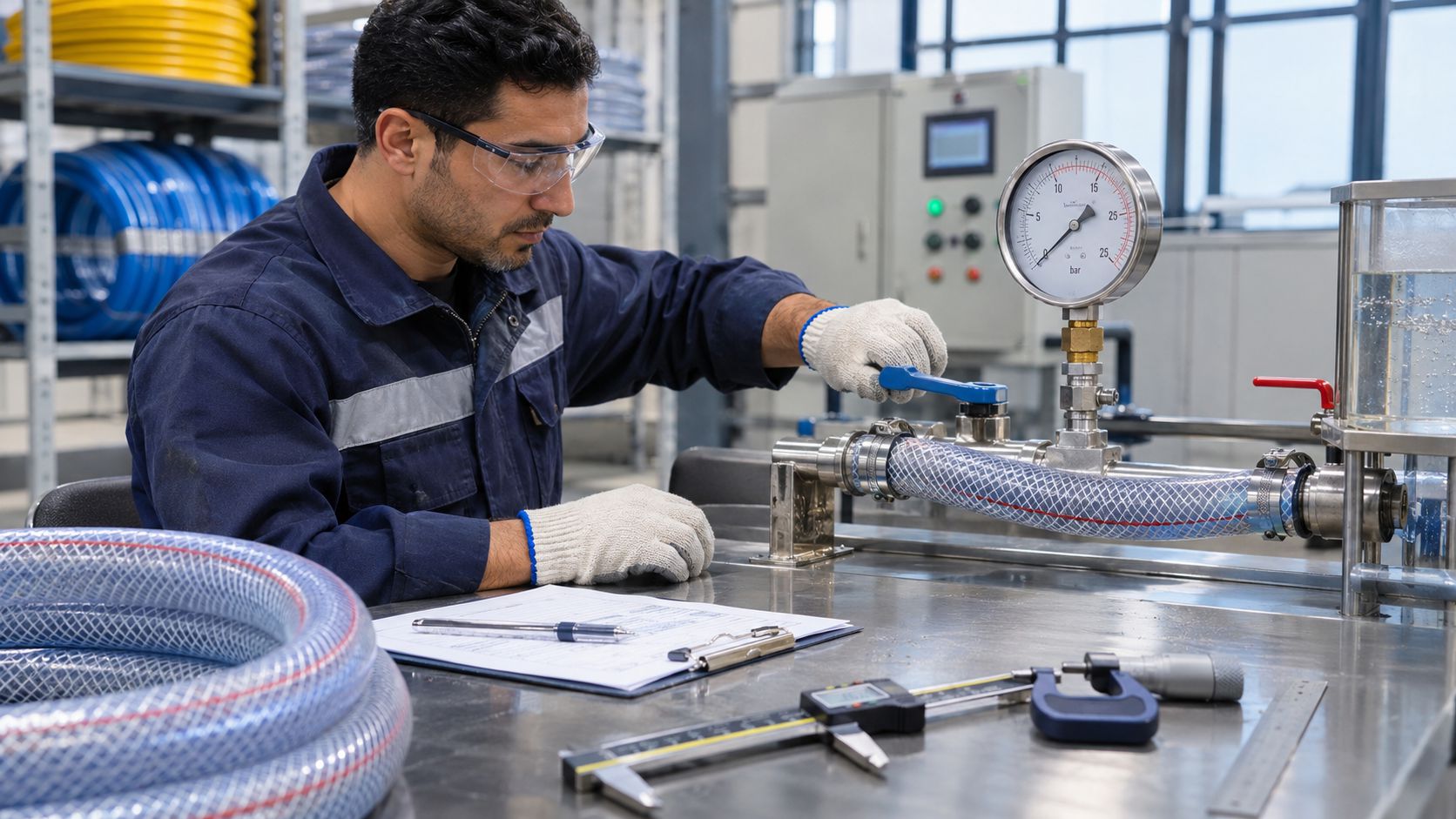 4. Cheap PVC Hose vs Quality PVC Hose: Which Has the Lower Total Cost?
A cheap PVC hose may offer a lower initial FOB price.
But wholesale profitability depends on how much usable product reaches paying customers and how much the importer spends on claims, handling, and replacement.
Example: 20,000-Meter Wholesale Order
The following is a hypothetical financial model, not a current market quotation or actual measured defect-rate comparison.
| Cost Factor | Low-Cost Hose | Quality-Controlled Hose |
|---|---|---|
| Ordered quantity | 20,000 m | 20,000 m |
| FOB unit price | $0.70/m | $0.82/m |
| Product purchase cost | $14,000 | $16,400 |
| Illustrative freight and handling | $2,500 | $2,500 |
| Assumed unsaleable quantity | 6% | 1% |
| Saleable quantity | 18,800 m | 19,800 m |
| Illustrative claims and handling | $1,200 | $200 |
| Total modeled cost | $17,700 | $19,100 |
| Cost per saleable meter | $0.941/m | $0.965/m |
In this scenario, the quality-controlled hose has a higher cost per saleable meter.
This illustrates an important point: better technical quality does not automatically produce a lower landed cost.
However, the higher-priced hose may still be commercially preferable if it reduces business interruption, safety risks, reputational damage, or customer losses that are not fully captured in this simple model.
The Correct Purchasing Formula
Cost per saleable meter = (Product cost + freight + attributable claims and handling + other relevant costs) ÷ Saleable meters
Importers should also account for:
- Customs duties and applicable taxes.
- Local port handling.
- Inland transportation.
- Financing and storage costs.
- Distributor warranty commitments.
- Costs of replacing failed products.
A cost model becomes more useful when buyers replace assumptions with actual historical claim data and verified supplier performance.
5. Which PVC Hose Products Are Suitable for Southeast Asian Markets?
Importers should build their product range based on the downstream applications they serve.
PVC Layflat Hose for Agricultural Irrigation
PVC layflat hoses are widely used as a product category for portable water delivery and discharge applications.
For agricultural distributors in Vietnam, Indonesia, Thailand, Cambodia, and the Philippines, important specifications include working pressure, hose diameter, reinforcement, abrasion resistance, and roll length.
Before ordering, confirm whether the hose can withstand the irrigation system’s normal operating pressure and pressure surges.
PVC Fiber Reinforced Hose for Water Delivery
PVC fiber reinforced hoses can be used for certain water delivery, agricultural, and industrial applications.
Procurement managers should compare:
- Nominal inner and outer diameter.
- Working pressure at the rated temperature.
- Burst-pressure test evidence.
- Bend radius and flexibility.
- Reinforcement consistency.
- Fitting compatibility.
PVC Suction Hose for Pumping and Drainage
For water pumps and drainage applications, buyers should verify suction and vacuum resistance.
A hose that performs well under positive pressure may collapse under vacuum if it is not designed for suction service.
For distributors serving water pump dealers, vacuum performance can be more important than an attractive purchase price.
PVC Steel Wire Hose for Industrial Applications
PVC steel wire reinforced hoses are used in selected industrial suction and fluid-transfer applications.
Buyers must confirm temperature limits, pressure ratings, chemical compatibility, and vacuum ratings for the specific model.
PVC Transparent Hose for General Fluid Transfer
PVC transparent hoses allow users to observe the movement of fluids.
However, transparency does not mean the hose is suitable for drinking water, food processing, chemicals, or compressed air.
Application-specific compliance and pressure ratings must be verified.
6. How to Identify Poor-Quality PVC Hoses Before Shipping
The most reliable way to evaluate PVC hoses is to use a documented inspection process.
A visual check can identify surface defects, but it cannot independently verify working pressure or long-term durability.
Pre-Shipment Quality Inspection Checklist
| Inspection Item | Verification Method |
|---|---|
| Inner diameter | Measure against approved specification |
| Outer diameter | Check agreed tolerances |
| Wall thickness | Measure using an agreed procedure |
| Hose length | Verify sampled rolls |
| Reinforcement | Inspect braid or spiral consistency |
| Surface appearance | Check visible defects |
| Working pressure | Review product-specific rating evidence |
| Hydrostatic testing | Conduct agreed tests where applicable |
| Packaging | Verify roll counts, labels, and markings |
| Loading quantity | Check packing list and loading records |
Five Warning Signs
- The supplier quotes a working pressure without defining the reference temperature.
- The quotation provides a hose diameter but no wall thickness or relevant construction details.
- Test reports cannot be linked to the supplied product.
- The manufacturer cannot explain its product acceptance criteria.
- The supplier refuses reasonable inspection arrangements before shipment.
These warning signs indicate the need for further verification. They do not prove that a supplier’s products are defective.
7. How to Compare Chinese PVC Hose Manufacturers
For Southeast Asian importers, direct factory sourcing can offer product selection, packaging flexibility, and container-based purchasing opportunities.
However, price comparisons are meaningful only when the suppliers quote equivalent products.
Recommended Supplier Evaluation Matrix
| Evaluation Criterion | What to Verify |
|---|---|
| Factory information | Company registration and manufacturing details |
| Technical documentation | Product-specific datasheets |
| Pressure performance | Test methods and results |
| Batch consistency | Quality-control and traceability procedures |
| Customization | Available sizes, colors, and packaging |
| MOQ | Minimum quantity by product and specification |
| Container loading | Packing dimensions and loading estimates |
| Export documentation | Commercial invoice, packing list, origin documents |
| After-sales support | Warranty and claims procedures |
Request a Standardized RFQ
To compare offers fairly, send the same technical requirements to each supplier.
For example:
| RFQ Item | Illustrative Buyer Requirement |
|---|---|
| Hose type | PVC fiber reinforced hose |
| Inner diameter | 25 mm |
| Working pressure | 8 bar at 20°C |
| Roll length | 50 m |
| Color | Blue |
| Order volume | One 20GP or 40HQ container |
| Incoterm | FOB or CIF |
| Destination | Ho Chi Minh City, Vietnam |
| Packaging | Export packing or private label |
All technical values should be confirmed as compatible with the actual hose design.
This approach helps prevent suppliers from quoting different wall thicknesses, reinforcement levels, or pressure ratings for what appears to be the same product.
8. How Do Container Loading and Shipping Affect PVC Hose Cost?
Many large importers prefer full-container purchasing because it can simplify procurement and consolidate shipment volumes.
However, container economics depend on actual cargo volume, weight, packaging, and shipping charges.
Standard Container Reference Dimensions
| Container Type | Approx. Internal Length | Approx. Internal Width | Approx. Internal Height |
|---|---|---|---|
| 20GP | 5.90 m | 2.35 m | 2.39 m |
| 40HQ | 12.03 m | 2.35 m | 2.69 m |
These are typical internal dimensions. Actual equipment, payload, door dimensions, and loading limits vary.
Before placing a large order, buyers should request:
- Packed roll dimensions and weight.
- Estimated meters or rolls per container.
- Mixed-size loading options.
- Packaging details.
- Loading photographs or inspection arrangements.
Important Southeast Asian Import Ports
| Destination Country | Ports to Evaluate | Relevant Commercial Markets |
|---|---|---|
| Indonesia | Tanjung Priok, Tanjung Perak | Jakarta, Surabaya |
| Vietnam | Cat Lai, Hai Phong | Ho Chi Minh City, Hanoi and northern Vietnam |
| Thailand | Laem Chabang | Bangkok, Chonburi |
| Philippines | Manila, Cebu | Metro Manila, Cebu |
| Malaysia | Port Klang, Port of Tanjung Pelepas | Klang Valley, Johor |
| Cambodia | Sihanoukville Autonomous Port | Phnom Penh and surrounding markets |
Importers must confirm the actual service, terminal, freight rate, and customs requirements with their logistics provider.
FOB vs CIF for Southeast Asian Importers
Under FOB, the buyer generally arranges the main international freight and cargo insurance.
Under CIF, the seller arranges ocean freight and the required minimum cargo insurance to the named destination port.
Under Incoterms® 2020, risk under both terms generally transfers when the goods are on board at the port of shipment.
The better option depends on freight pricing, cargo insurance needs, and the importer’s shipping capabilities.
9. Why Consider Orientflex for Southeast Asia PVC Hose Wholesale?
Orientflex is a China-based PVC hose supplier offering product categories relevant to wholesale importers and industrial distributors.
The product range includes:
- PVC steel wire reinforced hose.
- PVC fiber reinforced hose.
- PVC layflat hose.
- PVC suction and discharge hose.
- PVC transparent hose.
For importers in Indonesia, Vietnam, Thailand, the Philippines, Malaysia, and Cambodia, Orientflex can be contacted for product specifications and full-container purchasing discussions.
What Can Importers Discuss with Orientflex?
Depending on the product and confirmed manufacturing capabilities, buyers may inquire about:
- Available PVC hose diameters.
- Product-specific pressure ratings.
- Roll lengths and packaging.
- Wholesale container orders.
- Private-label requirements.
- Mixed-product loading feasibility.
- FOB and CIF quotation options.
Buyers should verify the actual technical data, available test documentation, MOQ, and commercial terms before confirming an order.
Website: https://www.orientflexhose.com/
10. Frequently Asked Questions
Q1. Is cheap PVC hose always lower quality?
No. A lower-priced PVC hose may be suitable for lighter-duty applications or benefit from efficient production.
Buyers should compare construction, pressure performance, dimensional consistency, and application suitability rather than relying on price alone.
Q2. What is the main difference between cheap PVC hose and quality PVC hose?
The main difference is how reliably the product meets documented requirements.
Quality-controlled hoses should have defined specifications, appropriate test evidence, and consistent manufacturing performance.
Q3. Which PVC hoses are suitable for tropical climates?
The correct choice depends on operating temperature, sunlight exposure, fluid compatibility, pressure, and installation conditions.
Buyers should request product-specific temperature-pressure information and relevant outdoor-aging evidence.
Q4. How can Indonesian and Vietnamese importers verify PVC hose quality?
Use standardized specifications, approved samples, relevant test reports, agreed acceptance criteria, and pre-shipment inspection.
For pressure-rated hoses, review the manufacturer’s stated ratings and supporting hydrostatic test evidence.
Q5. What is a good working pressure for agricultural PVC hoses?
There is no universal rating.
The hose should be selected according to the irrigation pump, operating pressure, potential pressure surges, temperature, and application.
Q6. What standards are relevant to PVC hose testing?
ISO 1402:2021 provides recognized hydrostatic testing methods for rubber and plastics hoses and hose assemblies.
ISO 1307:2006 addresses certain hose size and dimensional requirements.
Product-specific standards and regulatory requirements may also apply.
Q7. Is a thicker PVC hose always better?
No. Wall thickness is important, but reinforcement, material formulation, and product design also determine performance.
The correct hose is the one that meets the intended service requirements.
Q8. How can wholesalers calculate the true cost of PVC hoses?
Compare landed cost per saleable meter, including the product price, freight, customs, handling, defects, and customer claims.
Using real shipment and warranty data produces a more reliable comparison than using the FOB price alone.
Q9. Can Southeast Asian distributors import PVC hoses directly from China?
Eligible businesses may purchase from Chinese manufacturers subject to applicable import regulations, customs procedures, and commercial requirements.
Local customs brokers should confirm HS classification, duties, and product-specific controls.
Q10. Can PVC hose suppliers support 20GP and 40HQ wholesale orders?
Some manufacturers support full-container purchasing.
Buyers should confirm the minimum order quantity, product mix, container loading plan, and shipment terms for their selected hose specifications.
Conclusion: Choose PVC Hose Quality Based on Total Procurement Value
Cheap PVC hoses and quality PVC hoses should be compared using the same technical requirements.
For wholesale importers, the best choice balances product cost, verified pressure performance, consistent manufacturing, application suitability, and total landed cost.
In tropical Southeast Asian markets, special attention should be given to temperature-dependent pressure ratings, outdoor exposure, and the requirements of agricultural and industrial users.
A structured supplier evaluation can help reduce procurement uncertainty and support long-term wholesale distribution.
Request a Wholesale PVC Hose Quotation for Southeast Asia
Are you a PVC hose importer, agricultural equipment wholesaler, or industrial distributor in Indonesia, Vietnam, Thailand, the Philippines, Malaysia, or Cambodia?
Contact Orientflex to discuss PVC hose specifications, OEM packaging, and 20GP/40HQ container quotations from China.
Please include your company name, hose type, diameter, required working pressure, estimated quantity, and destination port.
Orientflex — PVC Hose Supplier for International B2B Importers
Website: https://www.orientflexhose.com/
Regional purchasing inquiries: Jakarta, Surabaya, Ho Chi Minh City, Hanoi, Bangkok, Manila, Cebu, Kuala Lumpur, Phnom Penh, and other Southeast Asian markets.
Related posts


