China Leading Hydraulic Hose Manufacturer
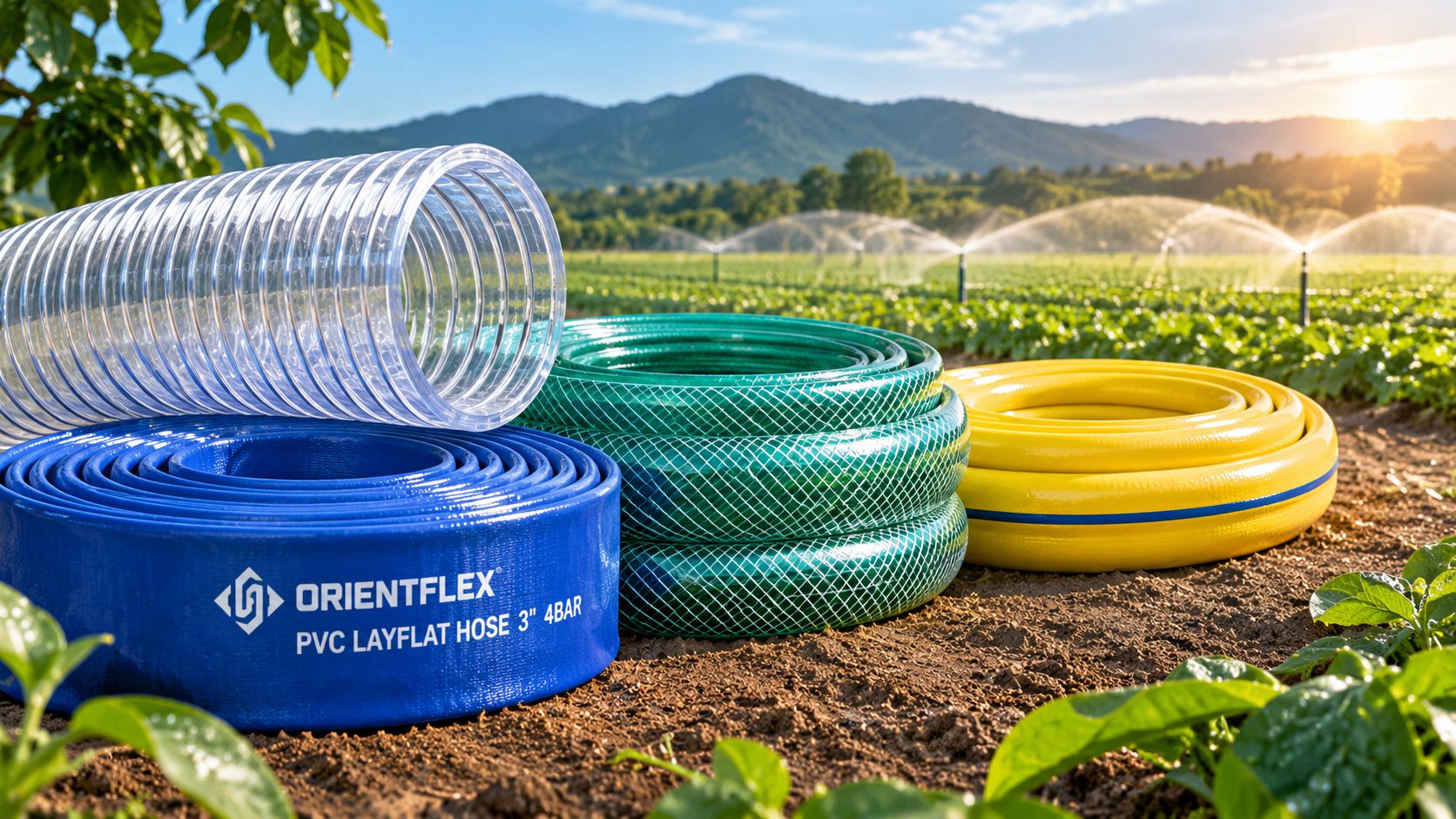
The best UV-resistant PVC hose for outdoor applications in Southeast Asia combines a weather-stabilized PVC compound, verified resistance to ultraviolet aging, suitable working pressure, and reliable performance under tropical heat and humidity. For importers and distributors in Indonesia, Vietnam, Thailand, the Philippines, and Malaysia, the correct hose must withstand its actual operating environment—not simply carry a “UV-resistant” label.
This guide explains how to compare outdoor PVC layflat hoses, fiber reinforced hoses, and suction hoses, evaluate UV test reports, prevent premature failures, and source container quantities for agricultural and industrial markets.
Why UV-Resistant PVC Hoses Matter in Southeast Asia
Southeast Asia includes tropical and subtropical environments where outdoor hoses may face intense sunlight, frequent rainfall, high humidity, and elevated temperatures.
PVC hoses are used in agriculture, water pumping, construction drainage, aquaculture, and industrial water-transfer operations.
For B2B distributors, environmental durability is important because hose failures can result in customer complaints, product returns, equipment downtime, and additional replacement costs.
Common Outdoor PVC Hose Problems
| Problem | Possible contributing factors | Purchasing implication |
|---|---|---|
| Surface cracking | UV exposure, heat, mechanical stress | Verify weathering and flexibility performance |
| Hose hardening | Material aging or plasticizer changes | Check retained mechanical properties |
| Loss of working-pressure capability | Elevated temperature or material degradation | Verify temperature-dependent pressure limits |
| Abrasion damage | Dragging across soil, gravel, or concrete | Evaluate cover durability |
| Kinking or deformation | Incorrect construction, handling, or routing | Check minimum bend requirements |
| Premature leakage | Insufficient pressure rating, defects, or damage | Review pressure and inspection records |
| Storage deterioration | Heat, direct sunlight, and inappropriate storage | Confirm warehouse handling instructions |
Humidity does not necessarily damage every PVC formulation directly. However, humid storage conditions can affect packaging, metal fittings, labels, and some product components.
Importers should assess the entire product and packaging system rather than assuming UV resistance alone ensures tropical durability.
Which PVC Hose Types Are Best for Outdoor Applications?
Different outdoor applications require different hose constructions.
For example, a hose used for temporary irrigation discharge is not necessarily appropriate for suction at a water pump inlet.
Selecting the correct structure is the first step in reducing field failures.
Comparison of Outdoor PVC Hose Types
| PVC hose type | Construction | Typical applications | Main selection factors |
|---|---|---|---|
| PVC layflat hose | Flexible PVC with textile reinforcement | Irrigation, drainage, water discharge | Pressure, UV aging, abrasion |
| PVC fiber reinforced hose | Textile braid between PVC layers | Pressurized water supply and industrial transfer | Pressure, flexibility, weathering |
| PVC suction hose | Flexible PVC with rigid spiral reinforcement | Pump suction and water transfer | Vacuum, crush resistance, UV aging |
| PVC steel wire hose | Flexible PVC with embedded steel helix | Selected industrial suction and transfer duties | Vacuum rating, fluid compatibility |
| PVC transparent hose | Transparent flexible PVC | Fluid observation and controlled transfer | Weathering, temperature, fluid suitability |
Not every hose in these categories is UV-stabilized.
The buyer should request confirmation for the exact product model and formulation.
1. UV-Resistant PVC Layflat Hose for Irrigation and Drainage
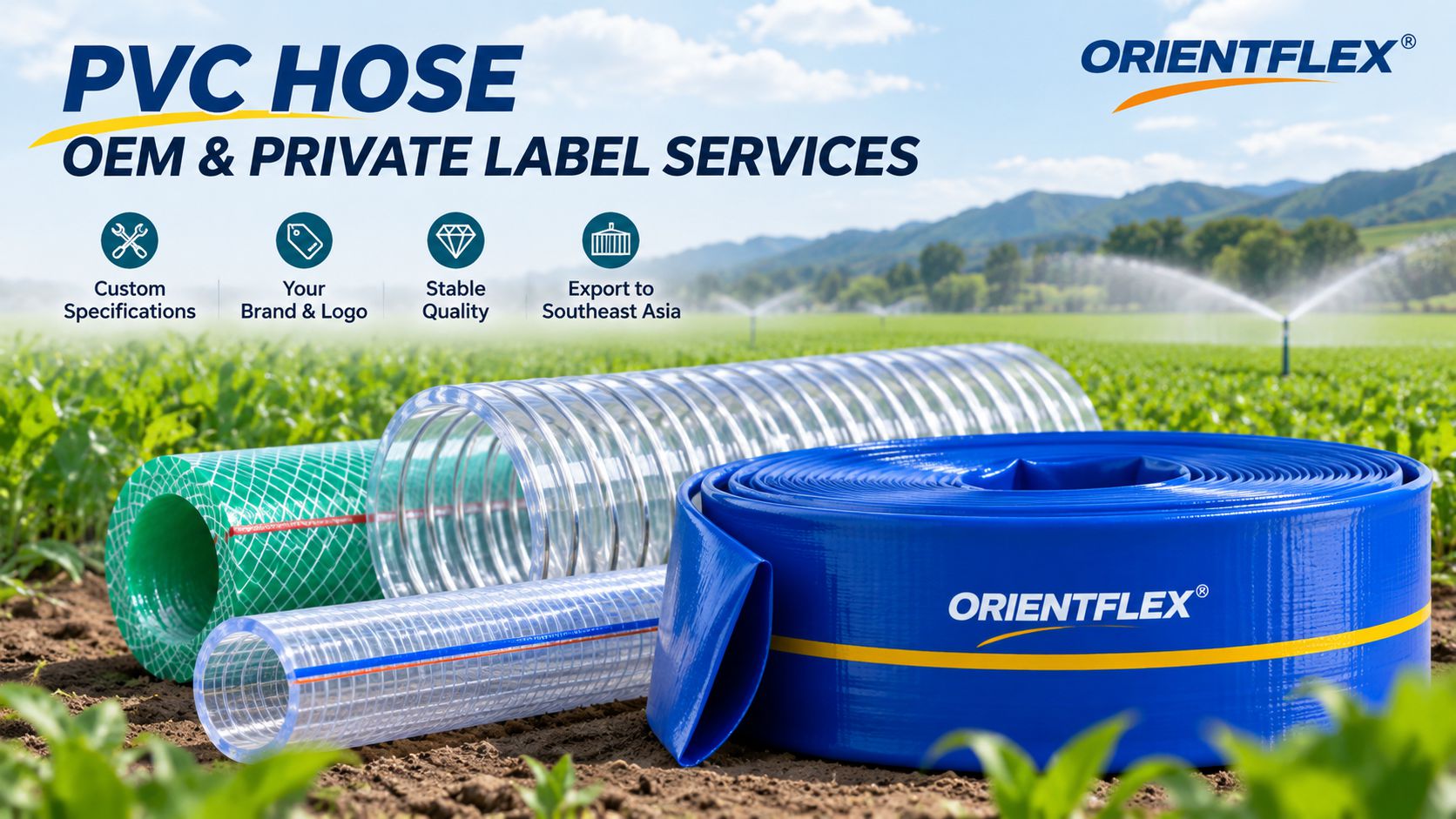
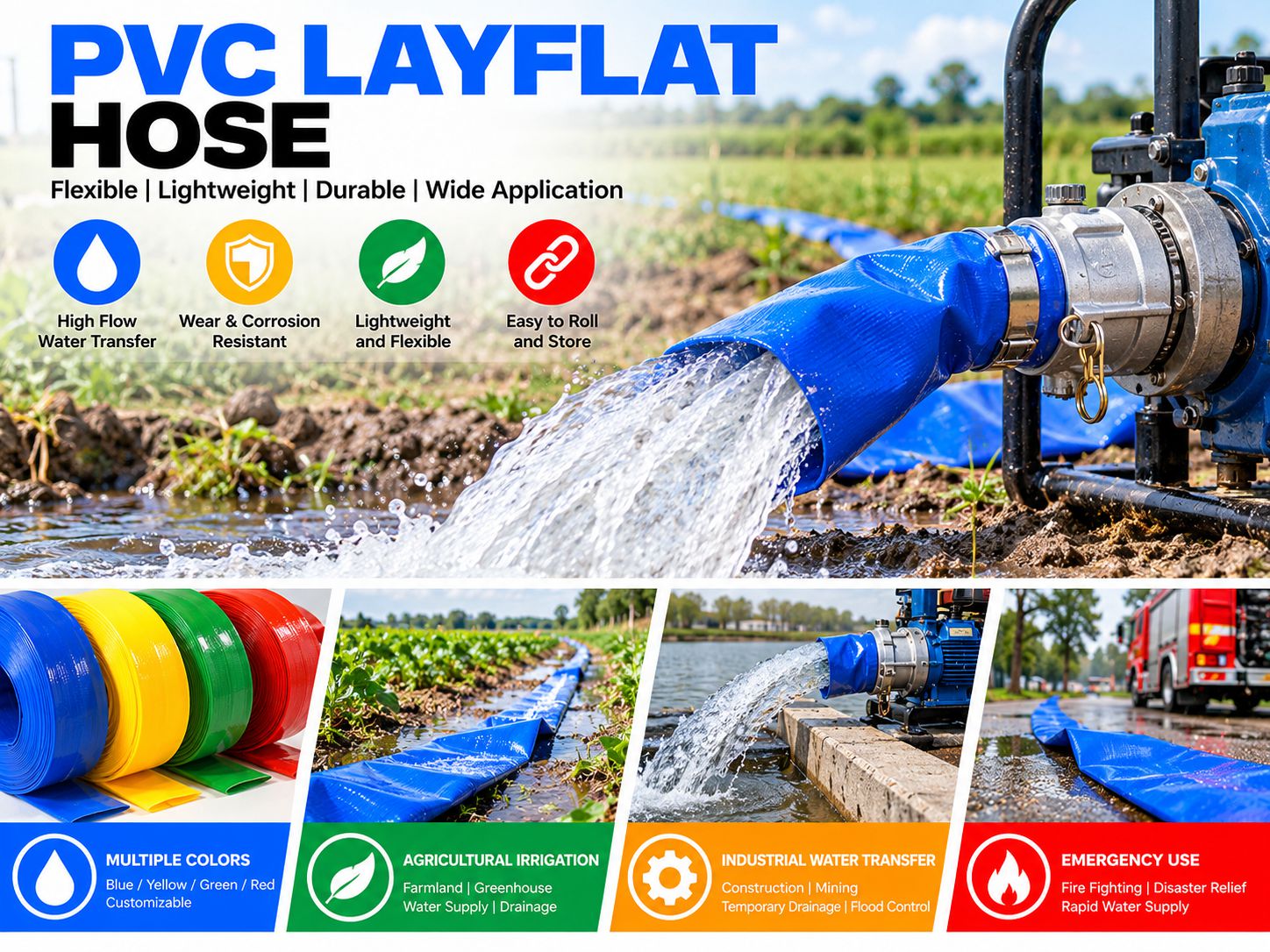
PVC layflat hose is a practical option for agricultural water delivery and temporary discharge systems.
When empty, it can be flattened and rolled into coils, making it convenient for transport and storage.
For Southeast Asian distributors, important product specifications include:
Nominal internal diameter.
Working pressure and burst pressure.
Reinforcement construction.
Wall thickness and tolerances.
UV aging performance.
Abrasion resistance.
Temperature limits.
Standard coil lengths.
A UV-stabilized PVC layflat hose may be suitable for repeated outdoor irrigation and drainage applications when its pressure and environmental ratings match the operating conditions.
2. PVC Fiber Reinforced Hose for Outdoor Water Transfer
PVC fiber reinforced hose commonly uses braided textile reinforcement to improve pressure resistance.
It may be suitable for pressurized water delivery and selected industrial applications.
For outdoor applications, buyers should verify weathering performance of the outer layer, working pressure at elevated temperatures, and resistance to repeated bending.
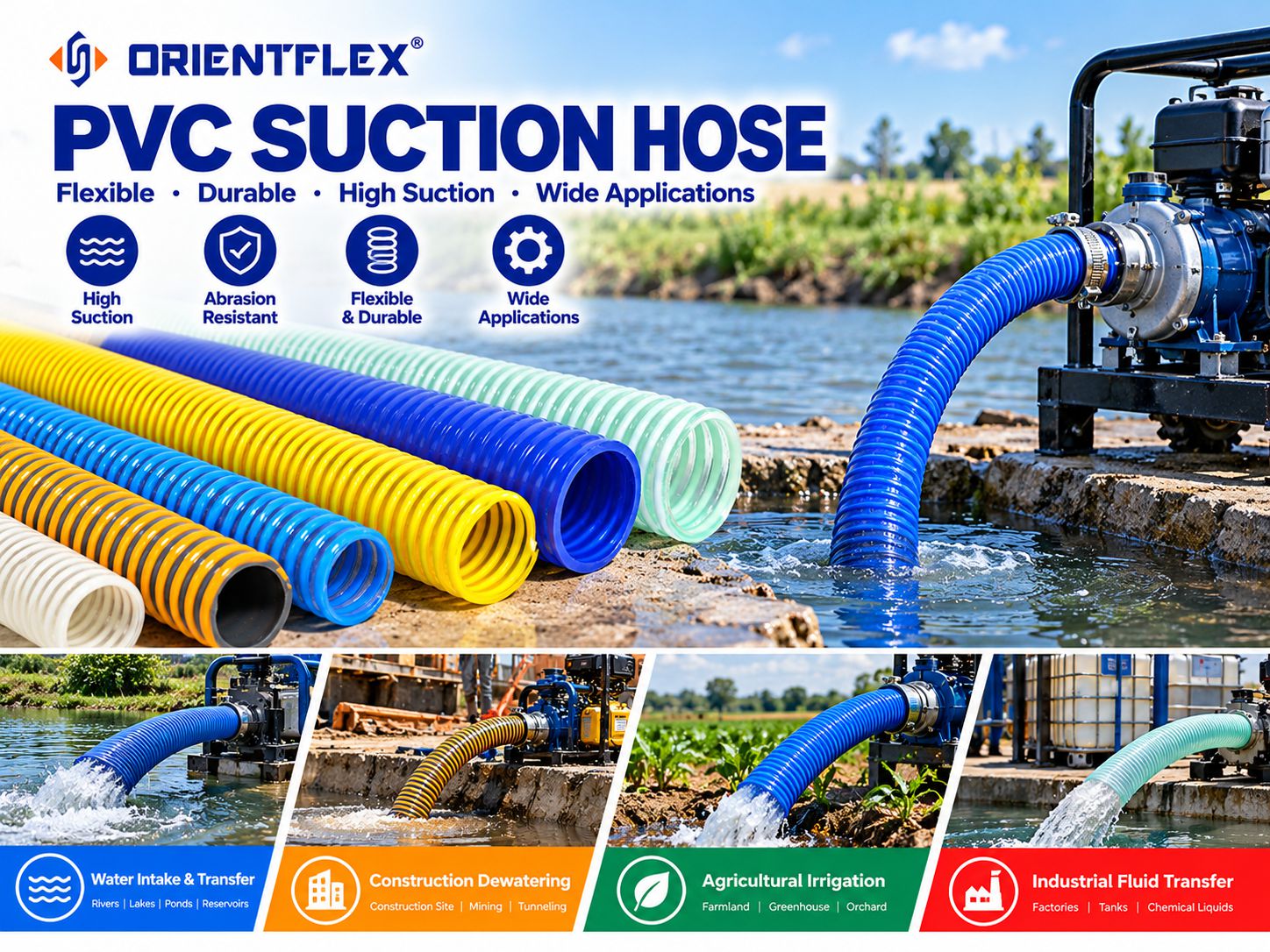
3. PVC Suction Hose for Agricultural Pumps
PVC suction hose typically contains a rigid PVC spiral reinforcement.
This structure helps the hose resist collapse when operating under vacuum.
It is relevant to agricultural pumps, water transfer, and dewatering operations.
A suction hose must be evaluated for vacuum service.
A standard PVC layflat discharge hose should not be substituted for suction duty unless specifically rated for that use.
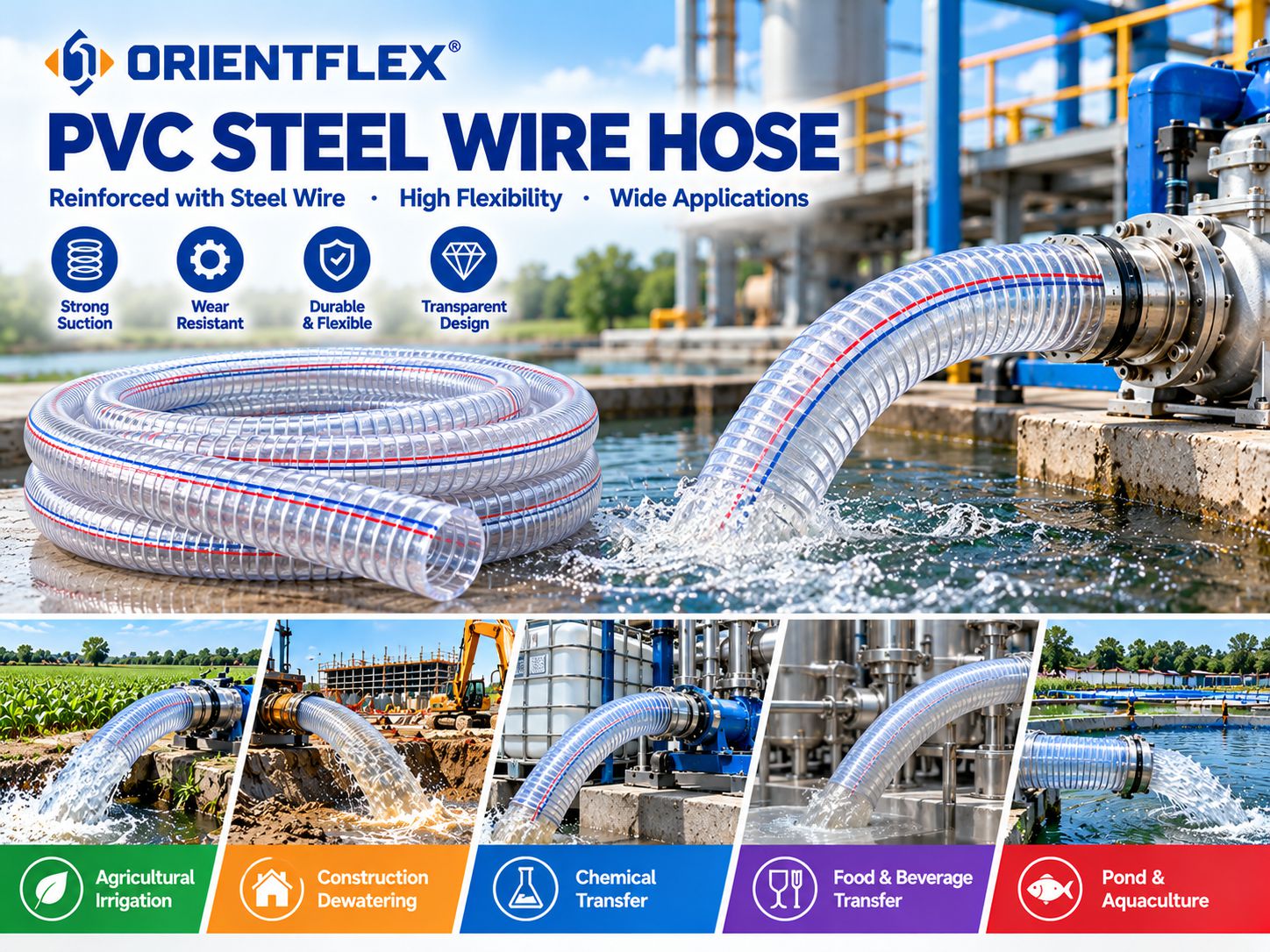
4. PVC Steel Wire Reinforced Hose
PVC steel wire reinforced hose is relevant to selected industrial suction and transfer applications.
Its steel helix provides structural support, but it does not automatically make the surrounding PVC material UV-resistant.
For outdoor use, importers should verify compound stability, vacuum performance, temperature limits, and fluid compatibility.
What Makes a PVC Hose UV-Resistant?
The UV resistance of a PVC hose depends on its compound formulation and construction.
Flexible PVC typically contains PVC resin, plasticizers, stabilizers, and selected additives.
To improve outdoor weathering performance, manufacturers may use UV stabilization systems, suitable pigments, and other additives.
Key Factors Affecting UV Resistance
| Material factor | Main function | What buyers should verify |
|---|---|---|
| PVC compound | Defines base mechanical properties | Material consistency |
| UV stabilizer system | Helps reduce radiation-related degradation | Weathering test results |
| Heat stabilizers | Support thermal stability | Heat-aging performance |
| Plasticizers | Provide flexibility | Flexibility and property retention |
| Pigments | Influence color and light interaction | Color stability and weathering |
| Textile reinforcement | Supports pressure resistance | Working and burst pressure |
| Spiral reinforcement | Supports suction performance | Vacuum rating and deformation resistance |
Is a Black PVC Hose More UV-Resistant Than a Blue Hose?
Not necessarily.
Some properly formulated opaque or black PVC compounds provide effective light shielding.
However, color alone does not establish UV resistance.
A blue hose with a validated weather-stabilization system may perform better than a black hose without suitable stabilization.
For professional importers, comparable weathering test reports provide stronger evidence than color-based marketing claims.
UV Resistance Testing Standards: What Importers Should Request
A supplier claiming that a hose is UV-resistant should be able to explain how the claim is supported.
Accelerated-weathering tests are commonly used to evaluate how polymer materials respond to controlled ultraviolet radiation, moisture, and temperature.
Common UV and Weathering Test References
| Standard | Test method | Procurement relevance |
|---|---|---|
| ISO 4892-2 | Xenon-arc weathering exposure | Simulates selected sunlight and weathering conditions |
| ISO 4892-3 | Fluorescent UV exposure | Evaluates material response to controlled UV radiation |
| ASTM G154 | Fluorescent UV exposure | Common accelerated-weathering practice |
| ASTM G155 | Xenon-arc exposure | Evaluates performance under controlled artificial exposure |
| ISO 4582 | Assessment of changes after weathering | Supports property comparison |
| ISO 527 series | Tensile testing of plastics | Measures properties of applicable material specimens |
These methods do not independently guarantee a specific outdoor service life.
A test report should state the exact method, exposure cycle, temperature, duration, sample description, and results.
Is 1,000 Hours of UV Testing Equal to Several Years Outdoors?
No.
A hose that completes 1,000 hours of accelerated UV exposure cannot automatically be described as suitable for three, five, or ten years of outdoor use.
Laboratory exposure and natural weathering are influenced by different conditions.
The relationship depends on the equipment, radiation intensity, exposure cycle, material formulation, local climate, and failure mechanism.
For suppliers selling UV-resistant PVC hoses in Southeast Asia, unsupported lifespan claims can create commercial and warranty risks.
Example UV Weathering Acceptance Criteria
The following is an illustrative buyer-defined testing specification, not an Orientflex product test result.
| Inspection item | Example requirement |
|---|---|
| Test method | ISO 4892-3 |
| Exposure duration | 1,000 hours |
| Exposure cycle | Agreed laboratory procedure |
| Visual result | No visible surface cracking |
| Tensile strength retention | At least 80% |
| Elongation retention | At least 70% |
| Post-aging pressure performance | Meet agreed acceptance criteria |
These are example purchasing thresholds, not universal pass/fail limits for PVC hoses.
Final requirements should be based on the relevant formulation, product construction, application, and validated test method.
For full-container purchases, buyers can request representative test reports and consider independent inspection.
 How Tropical Heat Affects PVC Hose Working Pressure
Southeast Asian buyers should evaluate UV resistance and temperature-dependent pressure performance separately.
PVC hose pressure ratings are typically based on specified test conditions.
At elevated temperatures, flexible PVC can change in stiffness and strength.
A hose rated for a particular pressure at one temperature may not have the same allowable pressure at a higher temperature.
Temperature and Pressure Evaluation Guide
| Hose temperature | What importers should check |
|---|---|
| 20°C | Manufacturer’s reference pressure rating |
| 30°C | Temperature derating requirements |
| 40°C | Allowable continuous working pressure |
| 50°C | Verified suitability and pressure limits |
| Above rated range | Manufacturer approval and alternative product selection |
The temperatures above are evaluation examples, not universal operating-temperature limits.
Example: An 8-Bar PVC Layflat Hose
Suppose a PVC layflat hose has a working-pressure rating of 8 bar at its stated reference temperature.
The buyer should not assume the hose can continuously operate at 8 bar when its material temperature reaches 50°C.
The manufacturer should provide an allowable pressure rating for the relevant temperature.
This matters for hoses exposed to sunlight while carrying pressurized water or operating near equipment that generates heat.
Additional Risk: Pressure Surges
Water pumps and rapidly operated valves can create pressure transients.
A hose must be selected with the actual operating conditions in mind.
UV stabilization cannot compensate for insufficient pressure capacity.
Importers should evaluate continuous pressure, potential pressure surges, temperature, and assembly requirements together.
 PVC Hose Requirements for Indonesia: Agriculture, Drainage and Water Transfer
Indonesia has diverse outdoor PVC hose applications across agriculture, construction, aquaculture, and water-management operations.
Regional environments vary significantly, including tropical rainfall, coastal humidity, and high temperatures.
Importers and wholesalers serving Jakarta, Surabaya, Medan, and other markets should select hoses based on application requirements rather than using one universal specification.
Relevant PVC Hose Categories for Indonesia
| Application | Hose category | Main requirement |
|---|---|---|
| Agricultural irrigation | PVC layflat hose | Pressure, weathering, field handling |
| Pump water suction | PVC suction hose | Vacuum and collapse resistance |
| Construction drainage | PVC layflat hose | Abrasion and discharge capacity |
| Aquaculture water transfer | Suitable PVC water-transfer hose | Fluid compatibility and flow |
| Industrial water supply | PVC fiber reinforced hose | Pressure and temperature limits |
Important Considerations for Indonesian Importers
Importers should verify UV-aging performance, pressure ratings, dimensional consistency, and packing quality.
For coastal storage facilities, packaging should also be evaluated against moisture, handling damage, and prolonged warehouse exposure.
Potential container gateways include Tanjung Priok and Tanjung Perak.
The correct port depends on the buyer’s distribution network and current shipping arrangements.
Before shipping, confirm relevant Indonesian customs and product-specific import requirements, including whether mandatory SNI requirements apply to the exact product classification.
UV-Resistant PVC Hose Supplier for Vietnam
Vietnam has important agricultural and industrial applications for outdoor PVC hoses.
Water-transfer products may be used for irrigation, drainage, construction pumping, and industrial operations.
PVC Hose Selection for Vietnamese Agriculture
The Mekong Delta is one relevant agricultural region where water-management equipment plays an important role.
For distributors supplying irrigation and pumping products, important specifications include:
Hose diameter and flow requirements.
Working pressure.
Vacuum resistance where applicable.
Weathering performance.
Flexibility and handling.
Packaging and product identification.
Rainy-Season Drainage Requirements
During periods of heavy rainfall, temporary water-transfer and drainage systems may require hoses capable of handling frequent pumping and movement.
For these applications, UV resistance alone is not the primary specification.
Importers should also evaluate abrasion resistance, appropriate discharge pressure, mechanical handling, and hose connection security.
Importing PVC Hoses into Vietnam
Cat Lai and the Hai Phong port area are examples of import gateways.
Buyers should verify Vietnamese customs procedures, applicable product regulations, and documentation requirements before confirming shipment.
UV-Resistant PVC Hoses for Thailand
Thailand has agricultural irrigation, construction, and industrial water-transfer applications that may require outdoor PVC hoses.
Importers serving Bangkok, Chonburi, Rayong, and agricultural distribution networks should evaluate both environmental durability and pressure performance.
Technical Priorities for Thailand
| Application condition | Recommended check |
|---|---|
| Outdoor irrigation | UV aging and rated working pressure |
| Agricultural pump suction | Vacuum performance |
| Industrial water transfer | Fluid compatibility and temperature |
| Construction drainage | Abrasion and mechanical strength |
| Frequent hose movement | Flexibility and bend requirements |
Choosing Between PVC Layflat and PVC Suction Hose
Use a suitably rated PVC layflat hose for applications requiring pressurized discharge through a collapsible hose.
Use a suitably rated PVC suction hose where the pump inlet operates under vacuum.
Do not select one solely because it is cheaper or has a similar diameter.
Laem Chabang and Bangkok-area port facilities may be considered depending on the shipment.
Buyers should verify the current import procedures and any applicable Thai Industrial Standards Institute requirements for the exact product.
UV-Resistant PVC Hoses for the Philippines
The Philippines has outdoor PVC hose applications in agriculture, construction, water pumping, aquaculture, and drainage.
Frequent rainfall and seasonal storms make correct water-discharge specifications important.
However, weathering resistance must still be evaluated for hoses exposed to direct sunlight between periods of use.
Main Purchasing Priorities
For Philippine importers, key factors include:
Appropriate pressure rating.
UV and weathering performance.
Flexibility and reinforcement.
Abrasion resistance.
Correct suction or discharge classification.
Coil packaging and shipment protection.
Floodwater and Construction Dewatering
PVC layflat hoses may be useful for temporary water discharge when properly rated for the equipment and operating conditions.
For suction, a reinforced suction hose should be selected.
Buyers should also evaluate debris exposure and abrasion. Ordinary PVC hoses may not be suitable for all abrasive slurry or contaminated-fluid applications.
Shipping to the Philippines
Manila and Cebu are relevant logistics gateways, depending on the buyer’s location and route availability.
For importers distributing to multiple islands, domestic freight and handling costs can be substantial components of landed cost.
Current customs and product-specific regulatory requirements should be confirmed before shipment.
UV-Resistant PVC Hose Wholesale for Malaysia
Malaysia has agricultural, industrial, construction, and water-transfer applications where PVC hoses may be exposed outdoors.
For importers serving Klang Valley, Penang, Johor, and other industrial regions, product consistency and technical documentation are important.
Recommended Product Evaluation
| Buyer requirement | Specification to verify |
|---|---|
| Outdoor weathering | UV-aging test results |
| Continuous water delivery | Working-pressure rating |
| Pump suction | Vacuum performance |
| Industrial water use | Fluid compatibility |
| Hot operating conditions | Temperature-related limits |
| Wholesale distribution | Batch and packaging consistency |
Port Klang and Tanjung Pelepas are potential import gateways.
Importers should check applicable Malaysian customs and product-specific conformity requirements before placing orders.
Opportunities in Cambodia, Myanmar and Laos
Cambodia, Myanmar, and Laos have agricultural and water-transfer applications where properly specified PVC hoses may be relevant.
For distributors entering these markets, a practical procurement strategy is to prioritize actual customer equipment requirements and shipment economics.
Market-Specific Considerations
| Market | Relevant applications | Logistics consideration |
|---|---|---|
| Cambodia | Agriculture, irrigation, construction water transfer | Port and inland distribution |
| Myanmar | Agriculture, pumping, industrial maintenance | Current import and shipping constraints |
| Laos | Agriculture, irrigation, construction | Landlocked transit and inland freight |
Import conditions, transport availability, and regulatory procedures may change.
Buyers should verify current market access and shipment feasibility before making commercial commitments.
Cheap PVC Hose vs. Documented UV-Resistant PVC Hose
A common purchasing problem in wholesale markets is comparing products based only on price per meter.
This can be misleading when the hose construction or performance specifications differ.
B2B Comparison
| Purchasing factor | Unverified low-cost hose | Documented UV-resistant hose |
|---|---|---|
| UV formulation | May be unspecified | Defined or supported by evidence |
| Weathering tests | May not be available | Relevant results supplied |
| Pressure rating | Requires verification | Size-specific rating documented |
| Temperature limits | May be unclear | Product limits provided |
| Mechanical consistency | Unknown | Can be evaluated |
| Batch identification | May be limited | Agreed traceability |
| Overall procurement risk | Less predictable | More measurable |
A higher-priced product is not necessarily superior.
Buyers should compare equivalent specifications and use test results to justify any price difference.
How to Calculate Landed Cost per Meter
Landed Cost per Meter = (Product Cost + Freight + Insurance + Duties + Customs Clearance + Inland Delivery) ÷ Saleable Meters
For Southeast Asian importers, shipment consolidation and correct container loading can influence the cost per meter.
Warranty expenses and confirmed product defects should be included in supplier performance evaluations.
How to Verify a UV-Resistant PVC Hose Manufacturer in China
For container-volume importers, supplier verification should be completed before bulk production.
Seven-Step Procurement Checklist
1. Confirm the application. Determine whether the hose is for irrigation, drainage, suction, or industrial water transfer.
2. Specify the construction. Include diameter, wall thickness, reinforcement, pressure rating, and required flexibility.
3. Define UV requirements. Request relevant weathering tests with agreed exposure conditions.
4. Verify temperature performance. Review allowable pressure at actual operating temperatures.
5. Check product samples. Inspect material appearance, dimensions, reinforcement, and handling characteristics.
6. Agree on batch inspection criteria. Document tolerances, markings, coil lengths, and packaging.
7. Confirm shipment details. Review container quantity, packing list, shipping terms, and destination requirements.
Pre-Shipment Inspection Checklist
| Inspection item | Requirement |
|---|---|
| Internal diameter | Within agreed tolerance |
| Wall thickness | Meets specification |
| Reinforcement | Matches approved construction |
| Working pressure | Supported by relevant test information |
| UV weathering | Agreed test evidence available |
| Surface condition | Free from unacceptable defects |
| Coil length | Matches purchase order |
| Batch marking | Traceable where agreed |
| Packaging | Suitable for export handling |
For higher-value container orders, importers may arrange third-party inspection based on a documented sampling plan and acceptance criteria.
20GP vs. 40HQ Container Orders for PVC Hoses
Container-volume purchasing is often relevant to large importers and wholesale distributors.
Container Comparison
| Container | Approximate internal volume | Sourcing consideration |
|---|---|---|
| 20GP | 33 m³ | Suitable where weight or order size favors a smaller container |
| 40HQ | 76 m³ | Greater volume for bulky hose coils |
Actual loading depends on hose diameter, coil dimensions, packing method, cargo weight, and container payload.
Buyers should request loading calculations rather than assuming a fixed number of meters per container.
Wholesale RFQ Example
| RFQ item | Example information |
|---|---|
| Hose type | PVC layflat / fiber reinforced / suction |
| Application | Irrigation, drainage, water pumping |
| Diameter | 2″, 3″, 4″, 6″ |
| Working pressure | Required bar rating |
| Operating temperature | Specified application temperature |
| UV requirement | Agreed weathering test criteria |
| Quantity | Meters per diameter |
| Packaging | Required coil length |
| Branding | Standard or OEM, if available |
| Destination | Jakarta, Ho Chi Minh City, Bangkok, Manila, Port Klang |
| Trade terms | FOB, CFR, CIF, or other agreed Incoterm |
The listed sizes are RFQ examples, not a verified inventory statement.
 Why Consider Orientflex for Outdoor PVC Hose Sourcing?
Orientflex is a China-based hose supplier that international wholesale buyers can evaluate for PVC hose sourcing.
For Southeast Asian importers, relevant products to discuss include:
PVC layflat hose.
PVC fiber reinforced hose.
PVC suction hose.
PVC steel wire reinforced hose.
PVC transparent hose.
Buyers should confirm which models are suitable for outdoor applications and whether validated UV-stabilized formulations are available.
For professional purchasing, request model-specific information covering working pressure, temperature limits, reinforcement, weathering performance, coil length, packaging, and available bulk quantities.
Official website: Orientflex PVC Hose Supplier
Frequently Asked Questions About UV-Resistant PVC Hoses
1. What is the best UV-resistant PVC hose for agricultural irrigation in Southeast Asia?
A suitably rated UV-stabilized PVC layflat hose is often appropriate for temporary irrigation water discharge. Buyers should check operating pressure, hose diameter, temperature limits, reinforcement, weathering performance, and field-handling conditions.
2. Are UV-resistant PVC hoses suitable for Indonesia’s tropical climate?
They can be suitable when the product’s UV-aging performance, working pressure, temperature rating, and construction match the intended application. High humidity and rainfall do not eliminate the need to evaluate sunlight exposure and mechanical wear.
3. What is the best PVC hose for rainy-season drainage in Vietnam?
A properly rated PVC layflat hose can be suitable for temporary water discharge. Where pump suction is required, a reinforced suction hose with the appropriate vacuum rating should be selected. Abrasion and debris exposure must also be considered.
4. How long do UV-resistant PVC hoses last outdoors?
There is no universal outdoor service-life figure. Actual lifespan depends on formulation, UV exposure, temperature, pressure, handling, and maintenance. Accelerated-weathering hours should not be converted directly into years of service without validated correlation.
5. What standards are used to test PVC hose UV resistance?
Common laboratory methods include ISO 4892-2, ISO 4892-3, ASTM G154, and ASTM G155. These define weathering exposure procedures. A buyer must also establish suitable acceptance criteria for the intended product.
6. Can a PVC hose rated at 8 bar operate at the same pressure in hot weather?
Not necessarily. Pressure ratings depend on the stated reference conditions. The allowable working pressure may change as the hose temperature increases. Buyers should request temperature-dependent pressure information from the manufacturer.
7. Is a black PVC hose always more UV-resistant than a blue hose?
No. Color alone cannot establish UV resistance. The relevant factors include pigment selection, UV stabilizers, compound formulation, and demonstrated weathering performance.
8. Can Philippine importers use PVC layflat hose for floodwater pumping?
A suitable PVC layflat hose may be used for discharge from an appropriate pump. However, the hose must be rated for the operating pressure and fluid conditions. Abrasive slurry, debris, or suction duty may require a different hose construction.
9. Can Southeast Asian wholesalers order mixed PVC hose sizes in one container?
Mixed-size orders may be available depending on the supplier’s production range, minimum order quantities, and packaging arrangements. Buyers should submit the required meters per size and request a loading plan.
10. What should I send to a Chinese manufacturer for a wholesale UV-resistant PVC hose quotation?
Provide the hose type, intended application, diameter, working pressure, temperature requirements, UV-weathering expectations, order quantities, packaging requirements, and destination port. Include any OEM branding or third-party inspection requirements.
Conclusion: Choosing the Right UV-Resistant PVC Hose for Southeast Asia
For importers and distributors in Southeast Asia, selecting an outdoor PVC hose requires more than choosing a product labeled “UV-resistant.”
The correct hose must provide suitable weathering performance, pressure capacity, temperature resistance, and mechanical durability for its intended application.
Agricultural irrigation, tropical water transfer, rainy-season drainage, and industrial pumping each create different technical requirements.
Buyers should prioritize documented product specifications, comparable test evidence, batch consistency, and realistic landed-cost calculations.
A well-defined purchasing specification helps importers reduce quality risks and establish more reliable wholesale supply relationships.
 Request a Wholesale UV-Resistant PVC Hose Quotation from Orientflex
Are you an importer, agricultural irrigation distributor, industrial hose wholesaler, or container-volume buyer in Southeast Asia?
Orientflex welcomes bulk PVC hose sourcing inquiries from businesses in Indonesia, Vietnam, Thailand, the Philippines, Malaysia, Cambodia, Myanmar, and Laos.
Whether your company supplies agricultural irrigation equipment in Indonesia, water-transfer products in Vietnam, construction drainage equipment in Thailand, or industrial hose distribution networks in Malaysia and the Philippines, contact our team to discuss suitable products.
Please include your required PVC hose type, diameter, working pressure, outdoor operating conditions, estimated order quantity, preferred packaging, and destination port.
Contact Orientflex to request technical specifications, available outdoor-use PVC hose options, and a wholesale container quotation.
Website: www.orientflexhose.com
Related posts


